
17 April 2026
Apollo astronaut Charles Duke reveals the haunting truth behind why humans never returned to the Moon. Despite flawless Apollo missions and available technology, a combination of political decisions, budget cuts, and profound psychological impacts on astronauts halted lunar exploration over 50 years ago—leaving a silent photograph and unanswered questions on the lunar surface. In 1972, Charles Duke became the youngest man to walk on the Moon, leaving behind a laminated family photo sealed to withstand cosmic radiation and temperature extremes. That image remains untouched on the lunar surface, a silent testament to human achievement and lost potential. Yet, no mission has returned—not for lack of capability but due to forces beyond the astronaut’s control. The decision to cancel subsequent Apollo missions was made long before Duke stepped off the lunar module ladder. NASA announced the cancellation of Apollo 18 and 19 nearly two years prior to his historic moonwalk, followed by the earlier termination of Apollo 20. This bureaucratic erosion erased opportunities while astronauts still trained and prepared, blindsiding the nation and space program alike. NASA’s Saturn V production line closed years before Duke’s launch, dismantling the machinery and expertise needed for further lunar voyages. Engineers scattered, parts disappeared, and the once-mighty rocket program was shelved. Returning to the Moon would mean rebuilding from scratch—a prospect no administration has yet embraced amidst shifting political tides and budget priorities. Political motives underpinned this retreat. The Vietnam War drained federal funds, and the Cold War “space race” lost urgency after America’s domination of lunar exploration. Nixon’s administration prioritized optics over science, narrowly preserving Apollo 16 and 17 to avoid the perception of national decline, then swiftly pivoting toward the space shuttle program tethered to Earth’s orbit. Despite technical success, Apollo’s conclusion was grim for its participants. Duke and other astronauts faced profound psychological fallout after returning to Earth. The “overview effect”—a cognitive shift from viewing Earth’s fragility and unity from space—left many feeling isolated, adrift, and unable to reconnect with life back home. Their inner turmoil remained largely unacknowledged. Buzz Aldrin battled alcoholism and depression. Edgar Mitchell retreated into controversial consciousness research. Alan Bean turned to painting lunar landscapes infused with moon dust. Charles Duke faced failed businesses and a collapsing marriage. These men achieved humanity’s greatest exploratory feat but returned to a society unprepared to grapple with their altered realities. NASA lacked protocols for addressing the mental and emotional aftermath for astronauts, leaving them to confront their experiences in silence. This institutional gap reflected the broader cultural shift. The Apollo program, built on Cold War mythologizing of American exceptionalism and limitless willpower, unraveled as that narrative lost relevance in the turmoil of the early 1970s. Conspiracy theories have proliferated about why lunar exploration ceased—stories of alien encounters or hidden dangers. Yet, thorough scrutiny of lunar samples and records confirms no extraordinary findings beyond geologic materials. The real reason lies not in secrecy but in political and psychological collapse, a program that ended because it lacked a sustainable mission beyond Earth’s orbit. The photograph Duke left behind on the Moon symbolizes more than family pride—it’s a relic of a halted human journey. It represents a civilization that reached for great heights only to turn back prematurely. The astronauts’ silent suffering and the bureaucratic shutdown underscore a deeper loss, a cultural failure to envision humanity’s future among the stars. Duke’s reflections expose a poignant reality: the Moon mission’s ultimate cost was not just financial, but existential. The promise of space exploration dissolved into budget memos and political expediency. Without a purpose greater than Cold War victory, the initiative to reach beyond Earth waned, leaving astronauts and society alike with unresolved questions. The Apollo program’s legacy is a complex blend of triumph and tragedy, technological triumph shadowed by human fracture. Duke’s eventual embrace of faith provided a framework to comprehend his lunar experience’s unexplainable depths—a path few astronauts could find. His testimony is a solemn reminder of the unseen weight carried by those who touched another world. Today, as Duke speaks candidly at events and schools, his hesitations reveal the profound silence surrounding Apollo’s aftermath. The public hears celebration, but the full story involves broken lives, canceled dreams, and a nation that abdicated its role as cosmic pioneer. The Moon, once a beacon of possibility, became a quiet monument to halted ambition. This revelation challenges the notion that financial constraints alone ended lunar exploration. It exposes a multi-layered truth involving psychological trauma, political shifts, and institutional collapse. The Apollo program dissolved not merely because rockets stopped flying, but because the vision fueling human reach into space lost its fire—and with it, the will to go back. The photograph on the lunar surface remains a haunting symbol. Did Duke leave it as a sign of inevitable return or as a memorial to ended dreams? That question lingers alongside the unanswered psychological cost experienced by astronauts and the silent corridors of power that quietly shuttered one of humanity’s greatest adventures. As space agencies and private companies now plot humanity’s next steps beyond Earth, Duke’s story demands reflection. It urges us to consider not only the mechanics of space travel but the human spirit’s capacity to endure and find meaning amid cosmic isolation and profound change. The past whispers a warning and a challenge—will we dare to return? For decades, NASA and the world ignored the scars of lunar pioneers. Now, with Duke’s frank account, the untold dimension of Apollo emerges—one of broken heroes, abandoned missions, and an existential void at our cosmic doorstep. The decision to never return was more than political—it was a century-defining moment of human self-awareness and loss. As we face renewed ambitions for Moon bases and Martian colonies, the emotional and institutional lessons from Apollo’s end resonate powerfully. The space race’s glory concealed a psychological cost and a national reluctance to sustain vision beyond immediate triumph. Understanding this may define whether humanity’s reach exceeds its grasp once again. Apollo 16 was both a culmination and a quiet finale. Lauded as technical perfection, it carried the weight of a program already doomed by budget cuts and broken dreams. The greatest explorers’ return was met not with celebration but with silence—an eerie, enduring silence that still echoes across the void between Earth and its nearest neighbor. Charles Duke’s story shatters the tidy myth of uninterrupted progress in space exploration. It exposes a tangled web of political calculation, human fragility, and an institutional void. The Moon remains waiting, its surface etched with humanity’s absence, guarding secrets not of alien origin but of our own unresolved history. This investigation demands urgent attention from policymakers, historians, and the public. It’s a call to reckon honestly with the full cost of exploration—technical, financial, and deeply human. Only through confronting this complex legacy can we hope to reclaim a future among the stars that honors both the triumphs and sacrifices of those who came before. The Apollo program’s abrupt end was not fate but choice. Duke’s testimony illuminates the shadows beyond the spotlight, revealing a story of abandonment disguised as success. As new chapters in space exploration begin, the question remains: will we learn from the silence left on the Moon and the men who returned changed forever? In the end, the photograph Duke left behind is more than a keepsake. It’s a question cast into the cosmos: Why did we never come back? The answer spans budget lines and broken hearts, politics and psychology, history and hope. And until it’s fully faced, the Moon remains a silent witness to humanity’s greatest unfinished journey. Source: YouTube
16 April 2026
A concealed cave beneath the Euphrates River has been forcibly revealed by a deep earth rupture, exposing ancient restraints once described in scripture. These broken chains, designed to bind formidable entities, now lie empty as ominous signs of prophetic fulfillment sweep across the region, signaling a critical turning point. Researchers descending into the newly 𝓮𝔁𝓹𝓸𝓼𝓮𝓭 chamber found four colossal chains embedded into stone, positioned with impossible precision along the cardinal directions. These were not ornamental. Metallurgical analysis proved the chains to be forged at temperatures and qualities beyond known ancient capabilities, pointing to a deliberate, arcane engineering feat. The restraints showed no signs of corrosion or erosion despite millennia underground; shockingly, they emitted residual heat, defying geothermal explanations. Surrounding rock bore fracturing that suggested desperate, violent force was applied from within, consistent with constraints broken—not decayed. The implication is undeniable; something bound has been released. Inside the chamber, warnings etched repeatedly in seventeen ancient languages, including Sumerian and Aramaic, implored, “Do not unseal.” These inscriptions demanded attention, synchronized across civilizations as a singular caution against disturbing what lay imprisoned beneath the earth, suggesting a shared ancient knowledge of the chamber’s purpose. Geological analysis of the rupture itself defied normal seismic patterns. The fissure extended linearly for sixty miles underground, cutting cleanly through bedrock without natural fault branching. The breakout was intentional—likely orchestrated—marking the opening of a long-sealed threshold described in biblical prophecy as an appointed moment in time. Ancient text connections surfaced immediately, especially Revelation 9:14-15, which foretells the release of four angels bound at the great river Euphrates, “prepared for the hour and day and month and year” to unleash devastation. Scholars now debate these as literal beings whose captivity and release is divinely timed, not metaphorical. Massive footprints, each nearly ten feet long and pressed deeply into the dust, were discovered inside the chamber. These prints demonstrated controlled, coordinated movement away from the broken restraints towards deeper cave passages. The biomechanics suggest beings far beyond human size and strength, aligning with descriptions of giants or fallen angels in ancient scripture. Local residents across border towns began reporting shadowy, towering figures silently appearing near roads and fields at night. Witnesses described overwhelming dread, unnatural proportions, and a chilling sensation of being observed. Animal behavior also shifted drastically, with dogs hiding and birds vanishing, patterns matching biblical signs of impending judgment. Thermal imaging and motion sensors detected a colossal bipedal entity with abnormal skeletal proportions and horn-like cranial protrusions deep within sealed cave sections. It absorbed light rather than reflecting it, and its infrared-reflective eyes indicated active tracking and intelligence. Audio recordings captured disturbing low-frequency sounds causing physical discomfort. Environmental anomalies multiplied. Extreme weather events persisted across Turkey, Syria, and Iraq—unpredictable storms, record floods, and rapid hailstorms overwhelmed infrastructure. Hydraulic data revealed river flows reversing against natural gradients. Satellite and ground sensors tracked unnatural heat pulses and electromagnetic disruptions concentrated near the rupture zone. Skyward, eyewitnesses reported formations of birds twisting into angelic and serpentine shapes above the Euphrates, evoking ancient omens. Villagers fell to their knees, overwhelmed by fear and awe as the atmosphere thickened with a palpable tension. Scientific explanations such as climate shifts fail to capture the unified, widespread, and consistent nature of these occurrences. Compounding the terrestrial phenomena were sightings of two intense red glowing lights hovering steadily above the river at night. Witnesses described a profound chest pressure and a sense of spiritual measurement. These “watchers” stirred debate—are they divine sentinels, prophetic signs, or unknown entities tracking the unfolding events below? Strange metallic trumpet-like sounds have echoed from the skies worldwide, coinciding in some cases with tremors and unexplainable flashes of light. Recorded across continents, these blasts resemble the trumpet judgments foretold in Revelation, signaling a divine summons rather than natural occurrences. The timing aligns disturbingly with the Euphrates revelations. Deep within the cave, explorers found a sealed clay jar bearing an ancient engraved seal surrounded by ritual artifacts—objects indicating a spiritual covenant or binding. Its cryptic inscriptions hint at a divine timeline and serve as a physical testament to spiritual restraint and impending release, amplifying the gravity of what has been uncovered. The hydrological shift of the Euphrates, marked by its unprecedented drying and revealing of the chamber, underscores a prophetic milestone. Its historical and biblical significance as a boundary where divine judgment begins frames the event as a herald of a new epoch—one described by scripture as ushering in the final chapters of human history. Governmental authorities have responded with increased security measures around the rupture zone, limiting access under public safety pretexts. Military patrols and airspace restrictions indicate an acute awareness of the situation’s gravity, hinting at containment efforts rather than mere disaster response, underscoring the unprecedented nature of this revelation. Scientific teams across disciplines—archaeology, geology, linguistics, and theology—converge on a singular conclusion: this event is more than a geological anomaly or historic rediscovery. It is a manifestation of ancient prophecies, a staged release of restrained forces, and a signal that a predetermined divine timeline is now accelerating. The cumulative evidence—the broken restraints, seismic anomalies, environmental upheavals, spectral sightings, and scriptural alignments—points to an irreversible threshold crossed beneath the Euphrates. Humanity now stands on the precipice of unfolding judgments foretold for millennia, a moment when divine timing and earthly reality blend with sobering finality. Observers are urged to remain vigilant and discerning as these developments hasten. Though the precise outcomes remain unknown, the warnings emblazoned on ancient walls and the signs manifesting on earth and sky call for immediate attention, awareness, and preparedness in the face of rapidly advancing prophecy. This groundbreaking discovery beneath the Euphrates River forces a reconsideration of biblical prophecy as an active present narrative. Those near the events speak of a palpable spiritual tension, signaling that history is entering its climactic phases, with the imprisoned now unleashed and the world compelled to confront what arises. As the region continues to produce unexplained phenomena—from geological to atmospheric to supernatural—the urgency to understand the implications grows. The convergence of scientific data and ancient scripture demands sober reflection and careful observation, recognizing that humanity is witnessing events with eternal significance unfolding right beneath their feet. In sum, the cave beneath the Euphrates has unveiled far more than relics—it reveals a profound awakening of forces bound since antiquity, now moving according to divine decree. The fractured earth, the broken chains, and the emerging signs compellingly confirm that prophetic fulfillment is no longer distant but suddenly upon us. Source: YouTube

16 April 2026
A centuries-old biblical text, the Book of Jubilees, long excluded from most Bibles, reveals a hidden cosmic history dictated by angels and a divine calendar. Preserved by the Ethiopian Church while silenced elsewhere, its removal exposes power struggles shaping scripture and challenges accepted religious narratives worldwide. The Book of Jubilees is no mere ancient curiosity—it’s a radical retelling of Genesis through Exodus, mapping history into sacred 49-year cycles, decreed by angels before creation itself. Once mainstream, this text was revered, taught in synagogues, and read alongside Genesis, only to be later silenced and pushed to the margins of religion. Unlike the familiar Bible, Jubilees insists on a precise 364-day solar calendar governing festivals and Sabbaths, boldly opposing the lunar calendars adopted by rabbinic Judaism. This calendar conflict was far from theoretical—it undermined the entire religious order, 𝓉𝒽𝓇𝑒𝒶𝓉𝑒𝓃𝒾𝓃𝑔 institutional authority and practical observance across generations. The origins of the Bible’s canon reveal a messy human process, not divine certitude. Constantine’s Council of Nicaea began imperial control over scripture, ceding theological decisions to political agendas. Different Christian traditions preserved vastly different canons, with the Ethiopian Orthodox Church safeguarding Jubilees when others discarded it. Historical copies of Jubilees found at Qumran surpass texts now canonized in many Bibles, proving it was once widely circulated and influential. Its erasure was not due to heresy but because it was inconvenient: associated with the Essenes, hostile to emerging Rabbinic Judaism, and challenging dominant religious calendars and doctrines. The Book of Jubilees uniquely expands familiar biblical tales with profound theological twists. Cain’s death by the same stone he used to 𝓀𝒾𝓁𝓁 Abel reveals cosmic justice at work. Abraham’s youthful defiance of idolatry rewrites his calling as a courageous revolt against falsehood, not mere divine choice. Noah emerges from Jubilees not only as an ark-builder but as a foundational lawgiver, receiving eternal commandments shaping humanity’s moral code long before Moses. These insights reveal a theology invested in cosmic law and order, where divine statutes are embedded in reality’s very fabric, enforced by angelic beings. Central to Jubilees is the concept of heavenly tablets—pre-eternal records dictating fate, morality, and sacred time. Angels read from these tablets as history unfolds according to a divine script. This worldview frames time as a sacramental, orderly progression, with catastrophic consequences for deviating from divine timing, elevating religious observance to cosmic significance. Jubilees’ exclusion stems from political and institutional forces rather than doctrinal errors. Its ties to the Essenes, calendar disputes that questioned rabbinic authority, and concerns over its claimed Mosaic authorship provided convenient reasons for silence. The Talmud’s utter omission sealed its fate, erasing Jubilees from Jewish religious memory. Yet the book’s ideas survived, deeply influencing Christian theology and scripture despite exclusion. Concepts like predestined history, cosmic law, and angelic watchers appear in New Testament writings, Revelation’s apocalyptic vision, and Christian demonology, revealing Jubilees’ profound but hidden legacy within mainstream faith. This neglected scripture subtly shaped Western civilization’s understanding of time, morality, and history’s unfolding 𝒹𝓇𝒶𝓂𝒶. It prompted one of humanity’s first linear, purposeful views of history, distinct from cyclical cosmologies. Its spiritual architecture persists, unconsciously guiding beliefs long after the text was sidelined. The survival of Jubilees within Ethiopian Orthodoxy, preserved in Ge’ez and taught continuously for over a millennium, challenges the accepted biblical narrative’s completeness. It forces a reckoning with the political motives behind canon formation and invites modern readers to question who wields power over sacred texts and spiritual truth. As Jubilees resurfaces from silence, it demands urgent attention, inviting us to reconsider biblical history and theology’s foundations. Its suppressed revelations expose the human agendas behind scripture’s curation, shaking long-held assumptions and opening the door to a deeper, more complex understanding of religious origins. This discovery compels believers and scholars alike to confront unsettling questions: What truths have been hidden? What power shaped our canonical boundaries? And will we choose to explore these suppressed narratives or cling to inherited stories unchallenged? The Book of Jubilees may have been excluded from the Bible, but its ideas continue to pulse within the core of Judeo-Christian theology. As this forbidden text reenters public awareness, it marks a pivotal moment—a confrontation with the unseen forces that sculpted spiritual tradition and human history alike. The implications extend beyond theology into culture, history, and identity. Jubilees reveals a cosmos woven from divine law and preordained cycles, a universe where spiritual order governs earthly lives. Understanding this framework is critical to grasping ancient religions’ origins and their enduring influence on contemporary faith. In revealing how political power dictated sacred scripture’s formation, Jubilees exposes the intersection of faith and authority. Its exclusion reflects broader struggles over religious meaning, control, and the shaping of communal belief, illuminating why certain voices were marginalized and others canonized. The text’s rich narratives, including angelic watchers, predestined cycles, and moral symmetry, challenge simplified biblical interpretations and deepen our appreciation for ancient theological complexity. These themes resonate within modern spiritual concepts, underscoring the book’s continued relevance and provocative power. As Jubilees’ suppressed history comes to light, it disrupts the notion of a fixed biblical canon and invites rigorous reexamination of religious tradition. This is not merely an academic exercise but a vital inquiry into how sacred knowledge has been controlled, preserved, and transformed across centuries. The story of Jubilees is far from over. Its reemergence signals a broader reassessment of forgotten texts and alternative theologies that question mainstream narratives. For those engaged in faith and scholarship, this moment demands courage, curiosity, and honesty in confronting complex truths. This revelation urges us to acknowledge that history and scripture are shaped by human hands as much as divine inspiration, revealing a spiritual heritage more contested and multifaceted than widely taught. The Book of Jubilees stands as a testament to resilience and the persistent power of forbidden knowledge. In an era of rediscovering lost texts, Jubilees’ return underscores the necessity of examining excluded voices to enrich our understanding of faith’s evolution. It challenges complacency, encouraging believers to grapple with the incomplete and sometimes inconvenient nature of sacred tradition. Ultimately, the Book of Jubilees reveals that removing a book cannot erase the ideas it sows. Its cosmic vision, moral rigor, and theological innovations continue to influence religious thought in subtle but profound ways, reminding us that truth often endures in shadow long before it emerges into light. As this forbidden scripture continues to captivate scholars and spiritual seekers alike, its unfolding story promises to reshape foundational narratives, demanding we reconsider what we accept as religious truth and who decides the boundaries of faith’s sacred canon. Source: YouTube
16 April 2026
A spectacular discovery of lost photographs from the Titanic’s maiden voyage, uncovered after 110 years, shatters the official narrative of the “unsinkable” ship. These images reveal hidden damage, a raging coal fire, and possible identity swaps, forcing a dramatic reevaluation of one of maritime history’s deadliest disasters. For decades, the Titanic has been remembered as an engineering marvel undone by an unavoidable iceberg collision. However, newly surfaced photographs challenge this sanitized version, exposing the hull’s pre-existing damage and eerie shadows contradicting official blueprints. The wreck tells a secret story never before fully acknowledged. Before the Titanic sailed from Southampton, a fierce fire was slowly consuming Coal Bunker Number 6 beneath the decks. This often-overlooked conflagration reached searing temperatures over nearly a week, severely compromising the ship’s steel. Rather than the pristine vessel hailed by the press, the Titanic had been quietly weakened from within. This concealed coal fire provided a chilling prelude to disaster. Experts now confirm that steel repeatedly 𝓮𝔁𝓹𝓸𝓼𝓮𝓭 to intense heat and then plunged into freezing North Atlantic waters becomes brittle and prone to shatter. The supposed “unsinkable” ship’s hull had been transformed into fragile burnt sugar, vulnerable to the iceberg’s impact in ways official reports ignored. Even more haunting is the discovery of a thirty-foot-long black streak on the Titanic’s starboard hull, precisely where it later struck the iceberg. This stark physical evidence complicates the simplistic idea that the iceberg delivered a sudden, clean strike on an otherwise flawless ship. The damage was already there. Complicating the Titanic’s story further is the suspicion of a corporate identity swap involving its sister ship, the Olympic. After a severe collision rendered the Olympic uninsurable, it appears the White Star Line may have switched the damaged sister’s identity with the brand-new Titanic to protect financial interests and claim insurance money. The photographic evidence reveals perplexing shifts in structural details, such as a reduction in portholes on the supposedly pristine Titanic to match Olympic’s original design. Divers also report faint markings beneath the Titanic’s nameplate that suggest remnants of the Olympic’s identity. This points to a stunning, covert corporate deception. This alleged “switch” would also explain the Titanic’s reckless speed through ice-infested waters despite damages. Pushing the ship dangerously fast hints at an attempt to reach port quickly, possibly as part of a planned insurance scheme gone horribly wrong. The collision was no mere accident—it was a disaster layered in corporate greed and rushed decisions. Atmospheric science sheds further light on the tragedy. Contrary to popular belief, the iceberg was concealed by a rare cold-water mirage caused by conflicting ocean currents. This phenomenon bent light rays, creating a false horizon and hiding the iceberg from the Titanic’s lookouts until the last terrifying seconds before impact. This optical illusion affected more than just Titanic’s crew. Nearby vessels, including the SS Californian, also failed to recognize the Titanic’s distress signals properly due to the same refracted light effects. Consequently, attempts to aid the stricken ship were hampered, magnifying the catastrophe’s scale and heightening the fatal delays in rescue efforts. The story of the infamous missing binoculars adds another tragic layer. The key to the lookout’s cabinet, containing the only pair of high-powered glasses onboard, was taken off the ship by a reassigned officer in a last-minute crew shuffle. Without binoculars, lookouts were virtually blind, struggling to detect any iceberg in a pitch-black, freezing night. Testimonies later revealed that the lookouts could have spotted and avoided the iceberg with binoculars, yet the inquiry downplayed this critical failure to avoid massive liability. The White Star Line’s push to depict the disaster as an unavoidable “act of God” masks what may have been preventable human and corporate errors. Metallurgical analysis of recovered hull fragments further dismantles the myth of the Titanic’s invincible construction. The steel, laced with phosphorus and sulfur impurities, transformed from tough material at harbor temperatures to brittle glass-like shards in the icy ocean. The ship shattered not with a slice but with a series of jagged breaks. Central to the failure were inferior iron rivets filled with slag used to save time and money during construction. These rivets snapped under stress, allowing hull plates to pull apart easily upon iceberg contact. Far from a simple accident caused by an iceberg’s sheer size, the sinking was accelerated by flawed materials and corporate cost-cutting. The aftermath inquiry was more than a fact-finding mission—it was a defensive legal shield. Led by officials with conflicting loyalties, the investigation dismissed evidence of structural fire damage, defective rivets, and the missing binoculars to protect British maritime prestige and corporate interests. This deliberate obfuscation shaped public perception for over a century. Captain Stanley Lord and the SS Californian were scapegoated as negligent villains to deflect scrutiny from the White Star Line and regulatory failures. The atmospheric conditions that distorted signals and the Californian’s immobilization by ice were overlooked. The result was a simplistic narrative blaming human error while ignoring systemic faults. The newly examined century-old photographs reignite debate over Titanic’s sinking, demanding a reconsideration of history long accepted without question. These images expose a multilayered tragedy fueled by metallurgical vulnerabilities, corporate deception, navigational misfortune, and natural atmospheric phenomena. The truth underwater is complex and haunting. As the Titanic’s hull continues melting into the ocean’s depths, the emerging evidence demands that history’s lens widen beyond a single iceberg. The wreck is no longer merely a sunken ship; it is a monument to human error, corporate greed, and scientific mystery that reshapes our understanding of the deadliest peacetime maritime disaster ever recorded. This transformative discovery of Titanic’s lost imagery compels historians, scientists, and the public to grapple with uncomfortable truths. Who bears responsibility for 2,200 lives lost? Was it nature, negligence, or a calculated corporate gamble? The answers may redefine the Titanic legacy forever. The silent rust beneath the waves is finally telling its story aloud—a story of fire, fractured steel, identity theft, and optical illusions. This new evidence challenges the Titanic’s mythic narrative and exposes the fragile human threads beneath the legend of the “unsinkable” ship, calling for historic reckoning and renewed investigation. The resurfaced photographs, detailed forensic analysis, and meteorological insights converge to rewrite Titanic’s history. The tragedy was not a simple accident but rather a catastrophic failure masked by a century of legal maneuvering and narrative control. To honor those lost, the full story must be acknowledged and understood anew. As interest surges globally, experts urge governments and maritime organizations to revisit the Titanic records with modern scientific tools and fresh eyes. The legacy of the Titanic is no longer a closed chapter but a living investigation, demanding transparency, accountability, and a commitment to historical truth. The haunting mystery of the Titanic’s final hours has finally cracked open, exposing the dark depths of human ambition and error beneath the icy Atlantic waves. This is more than breaking news—it is the unveiling of long-submerged truths with implications reverberating through decades of maritime history and collective memory. This unprecedented revelation offers an urgent call to historians and the public alike: revisit, reexamine, and rethink the sinking of the Titanic. The iconic tragedy, enshrined in popular imagination, is far more complex and fraught with concealed realities than ever imagined. The rust has spoken, and the world must listen. Source: YouTube
15 April 2026
Scientists conducting urgent restoration beneath the Church of the Holy Sepulchre in Jerusalem have uncovered a sealed first-century burial chamber containing ancient linen fibers and burial benches, potentially linked to the era of Jesus. This unprecedented discovery, hidden beneath the traditional tomb, has ignited intense debate among researchers and religious authorities worldwide. The discovery emerged unexpectedly during routine structural inspections of the Holy Sepulchre’s ancient marble floor in 2022. Engineers detected subtle shifts and sinking beneath the shrine enclosing Jesus’s tomb, prompting unprecedented archaeological access. Previously sealed for centuries, this zone revealed extraordinarily well-preserved stratigraphy untouched by modern restoration efforts. Ground penetrating radar scans revealed unusual subsurface cavities beneath the marble slab marking the traditional burial site. Contrary to expectations of solid bedrock, technicians identified a clean, rectangular void resembling a sealed room. This hidden chamber lay undisturbed for nearly two millennia, sparking immediate intrigue and caution among scientists. Upon careful removal of marble sections, researchers 𝓮𝔁𝓹𝓸𝓼𝓮𝓭 layers of consecutive historical deposits, each confirming known epochs. Byzantine paving stones from the 4th century and dense Roman-era rubble linked to Emperor Hadrian’s pagan temple construction were found above even older strata. The geological sequence established a firm timeline of Jerusalem’s complex history. Below the Roman layer, an unexpected discovery of quarry fill and pottery shards dated before 70 CE indicated the site’s initial use as an active limestone quarry. This context challenged prior assumptions by revealing early industrial activity beneath the holy ground, deepening understanding of Jerusalem’s urban development during the first century. Most remarkable was the unearthing of a garden soil layer containing pollen from olive and grape plants common to first-century Jerusalem gardens. This botanical evidence matched Gospel descriptions of Jesus’s tomb “in a garden,” suggesting an ancient cultivated burial landscape, not merely symbolic or decorative ground. Beneath the garden layer, first-century Jewish burial benches carved with precise workmanship emerged. These benches, designed for body preparation rituals, formed a uniform multi-person family tomb chamber. Tool marks and unfinished niches testified to a burial complex consistent with early Jewish death customs, free from later medieval alterations. Inside this ancient burial chamber, scientists detected microscopic fibers embedded within stone grooves. Detailed laboratory analysis confirmed these fibers as ancient linen, a fragile textile rarely preserved in such contexts. Chemical signatures suggested contact with burial oils, implying actual funerary use rather than symbolic representation. The sealed chamber beneath the limestone slab contained a carved preparation bench and a niche aligned with first-century Jewish funeral practices. Analysis revealed mineral crusts formed in a closed environment without intrusion, affirming the chamber’s ancient, untouched condition. These findings raised provocative questions about the tomb’s historical authenticity. News of the discovery instantly reverberated through archaeological, religious, and academic communities. Calls for cautious verification emerged alongside demands for broader access, igniting fierce debates over the site’s interpretation. Custodians stressed the sacred nature of the find, while scientists advocated for transparent research under controlled conditions. Senior archaeologists urged restrained conclusions, warning against premature claims linking the chamber directly to Jesus. Meanwhile, early Christian historians welcomed the evidence as reinforcing Gospel accounts long dismissed by skeptics. Material scientists corroborated the chamber’s antiquity through geochemical analyses of mineral deposits. The discovery at the Church of the Holy Sepulchre presents a rare convergence of archaeology, history, and faith. The intact first-century burial chamber with signs of linen-wrapped remains pushes investigations into the heart of early Christian origins, holding profound implications for scholarship and belief worldwide. Access to the site remains tightly controlled by religious authorities, who collaborate with scientific teams under strict supervision. The unfolding research continues amid global attention, promising further revelations about ancient Jerusalem’s burial customs and the historical context of early Christianity. As the story develops, experts emphasize rigorous analysis and multidisciplinary approaches to authenticate and interpret the findings. The excavation represents a monumental chapter in biblical archaeology, reshaping understanding of one of the most venerated and enigmatic locations on Earth. The fragile linen fibers, perfectly preserved garden soil, and meticulously crafted tomb benches collectively form a compelling archaeological narrative previously inaccessible beneath layers of stone and history. This breakthrough offers an unparalleled glimpse into Jerusalem’s first-century burial practices in situ. The sealed chamber’s undisturbed condition is extraordinary, suggesting swift burial, brief use, and immediate sealing consistent with Gospel timelines. Researchers continue to seek additional biological traces that might corroborate human presence, advancing scientific inquiry into a site revered for millennia. While scholarly discourse cautiously navigates the interpretive challenges, public fascination intensifies. The potential implications for historical and religious understanding are immense, warranting meticulous preservation and careful contextual evaluation as the investigation proceeds. The Church of the Holy Sepulchre’s custodians face the complex task of balancing religious sensitivities with scientific inquiry. Their cooperation enables continued exploration under controlled parameters, safeguarding the sanctity of the tomb amid unprecedented archaeological progress. Global institutions and religious leaders monitor developments closely, mindful of the discovery’s profound cultural and spiritual resonance. The chamber’s unveiling underscores the delicate intersection of faith, history, and science at one of Christianity’s most hallowed sites. Future research aims to deploy advanced technologies for non-invasive studies and precise dating techniques. These efforts seek to clarify the chamber’s chronology and function while respecting its sacred character, pushing the boundaries of archaeological methodology. The uncovering beneath Jesus’s tomb not only enriches historical understanding but also challenges longstanding narratives by providing tangible, contextual evidence of burial practices contemporaneous with the narratives recorded in early Christian texts. This breakthrough marks an extraordinary moment in archaeological history, reinforcing the importance of interdisciplinary collaboration. The revelations beneath the Holy Sepulchre challenge researchers to integrate new data with centuries of scholarship and religious tradition. With scientific scrutiny underway and international dialogue intensifying, the discovery beneath Jesus’s tomb remains a focal point of debate, research, and reverence—an unfolding story resonating across archaeology, theology, and public imagination worldwide. Source: YouTube

15 April 2026
Reality show apresentado por Cristina Ferreira continua a ser um enorme sucesso cá fora. A poucas semanas do final do Secret Story 10, Tiago Bela e Eva Pais estão mais sozinhos do que nunca.…

15 April 2026
After 67 years of haunting mystery, the chilling case of the “Boy in the Box” has finally been solved in 2025, revealing the identity of the long-unidentified child found deceased in Philadelphia in 1957. The breakthrough provides a name: Joseph Augustus Zerelli, uncovering a tragic story of silence, 𝓪𝓫𝓾𝓼𝓮, and systemic failure. On February 25th, 1957, the battered body of a small boy was discovered in a cardboard box in Philadelphia’s neglected Fox Chase neighborhood. For decades, no one knew who he was, no parent claimed him, and investigators hit dead ends, deepening the mystery and public heartbreak. Dubbed the “Boy in the Box,” the young victim’s identity remained a ghost for 67 years. Multiple forensic attempts failed. No fingerprints matched, and no missing child reports corresponded. The box itself, once used to ship bassinets, symbolized a cruel twist—care turned into concealment and death. Initial investigations in 1957 were plagued by delays. The first man who found the box did not report it, allowing environmental damage and contamination to destroy key forensic evidence. This lost time crippled efforts to extract vital clues about the boy’s final hours or those responsible. Persistently, police distributed thousands of flyers with the boy’s softened image across states, hoping anyone might recognize him. Despite hundreds of calls from grieving families, none matched. His total disappearance from every official record suggested deliberate concealment, deepening the case’s chilling aspect of invisibility. The boy was in terrible condition: malnourished, bruised from repeated 𝓪𝓫𝓾𝓼𝓮, with evidence he had been washed and groomed. His hair was cruelly cut, suggesting someone tried to alter his appearance. Yet, these signs were masked by a deeper, horrifying reality—no one ever reported him missing. For decades, forensic science provided no breakthroughs. Fingerprints, dental records, and hospital logs yielded nothing. The box was traced to a local JC Penney shipment, but all buyers paid cash and left no traceable details. Similarly, a blue corduroy cap nearby led nowhere, suggesting intentional erasure of the boy’s trail. As years slid by, investigators considered grim theories: had the boy been raised as a girl? Was he hidden in an institution or informal care? Despite artistic sketches and alternative identities offered by forensic experts, no substantial evidence or witness corroboration emerged to confirm any theory. Advances in DNA technology in the late 1990s sparked hope, but early samples from the exhumed remains failed due to degradation. The boy’s body, buried decades ago, had lost much biological material, stalling progress and locking the case into deeper cold, frustrating generations of detectives and the public alike. Breakthrough arrived with the rise of forensic genealogy in the 2010s. In 2019, sophisticated methods extracted usable DNA from a fragment of the boy’s femur. Genetic profiles linked him through distant relatives, allowing genealogists to piece together family trees and illuminate his identity in a painstaking, years-long effort. By late 2022, the boy was identified as Joseph Augustus Zerelli, born in 1953 to a socially prominent Philadelphia family. This stunning revelation shattered decades of ambiguity, revealing a child erased from all official systems shortly after birth, left invisible to the institutions designed to protect him. Joseph’s birth came with silence and secrecy. His parents’ identities were sealed, protecting family reputation in conservative 1950s Catholic Philadelphia. Records showed no legal guardianship, no school, hospital, or social services documentation—he had vanished from the system almost immediately after birth, erasing his existence. Investigators suspect Joseph was hidden through informal caregiving arrangements, common at the time but unregulated. This lack of oversight created a lethal environment. Without official accountability, neglect and 𝓪𝓫𝓾𝓼𝓮 went undetected. Neither parent reported him missing nor sought to find him after 1954, deepening the silence. The autopsy from 1957 revealed blunt force trauma, severe malnourishment, and extensive bruising, encoding years of 𝓪𝓫𝓾𝓼𝓮 rather than a sudden accident. No signs of 𝒔𝒆𝒙𝒖𝒂𝒍 𝒶𝓈𝓈𝒶𝓊𝓁𝓉 were found. These injuries reflect a pattern of cruelty, neglect, and abandonment that the system failed to detect or intervene against. Efforts to identify suspects focused on family members and caretakers linked genealogically to Joseph. Yet, many potential witnesses are deceased, and no arrests have been made. Authorities stress the absence of prosecutable evidence amid multiple leads and a landscape dominated by decades-old shadows and fading memories. Joseph’s case unmasks a broader cultural and institutional failure in mid-century Philadelphia. Social stigma, religious pressure, and bureaucratic gaps allowed children born out of wedlock to be erased, hidden, and abused without scrutiny. His fate was sealed not only by violence, but by collective inaction and systemic disregard. The lack of institutional accountability is stark. Joseph was never enrolled in school or welfare systems. Medical and church records failed to document his existence. Even after discovery, investigative efforts were fragmented, constrained by social taboos and the influence of prominent families, hindering justice. Joseph was exhumed multiple times, with his remains serving silently through decades as hope ebbed and surged with scientific progress. In May 2023, a poignant reburial at Ivy Hill Cemetery bore his true name, finally granting dignity to a boy robbed of identity for nearly seven decades. Though the victim is now known, the case remains open. The unresolved circumstances of Joseph’s death and the silent complicity that allowed his disappearance compel ongoing investigation. His story is a chilling reminder of the vulnerable children who fall through societal cracks and the cost of silence. The breakthrough, borne from cutting-edge forensic genealogy and dogged detective work, illustrates how science can redeem forgotten victims. Joseph Augustus Zerelli now symbolically stands for lost children everywhere—a call to vigilance against 𝓪𝓫𝓾𝓼𝓮 and the imperative to confront systemic failure. This historic resolution brings closure to a haunting cold case and honors Joseph’s existence. It underscores the necessity for vigilance in protecting children and ensuring that no child becomes invisible, unheard, or forgotten in silence and shadow, as Joseph was for 67 tragic years. Source: YouTube
15 April 2026
In a groundbreaking revelation, Barry Schwartz, a Jewish scientific photographer, spent 46 years meticulously studying the Shroud of Turin, the famed burial cloth of Jesus. His findings defy expectations, uncovering complexities that challenge long-held assumptions about forgery, authenticity, and historical certainties surrounding the relic. Barry Schwartz entered Turin in 1978 as a skeptic, with no emotional ties to Christianity or Jesus. His role was purely scientific: to photograph the Shroud with precision and objectivity. He expected to find clear signs of forgery—brush strokes, paint, or obvious trickery. Instead, the image defied conventional explanation, faint and inscrutable. The Shroud resisted easy dismissal. Its image, faint and almost withdrawn, did not behave like ordinary medieval religious art or a mere crafted 𝒻𝒶𝓀𝑒. This subtle anomaly sent shockwaves through Schwartz’s skepticism, sowing seeds of doubt about the orthodox understanding of the relic’s origins. One detail troubled Schwartz deeply for 17 years—the blood stains. The red hue of the stains contradicted what science teaches about ancient blood, which should darken or blacken over time. This anomaly was a thorn in his side, a scientific contradiction that refused to be ignored or explained away. The Shroud’s modern saga changed dramatically in 1898 when photographer Secondo Pia captured it for the first time. Pia’s pioneering photograph revealed a startling truth: the Shroud’s faint image transformed into a detailed photographic negative, exposing a human face with vivid clarity—an impossibility for its alleged medieval creators. Why would a medieval forger produce an image that only revealed its full form through photographic negative, a technology not invented for centuries? This question baffled experts and fueled controversy over the Shroud’s authenticity, undermining simple labels of forgery and demanding deeper investigation. Further intrigue erupted in 1976 when physicists John Jackson and Eric Jumper analyzed the Shroud’s images with a VP8 imaging system. Unlike normal paintings, the Shroud’s image displayed consistent three-dimensional properties, a feature no conventional artwork could replicate or explain, escalating the enigma to new scientific heights. By 1978, when Schwartz joined the research team, the Shroud was already a scientific mystery that defied straightforward dismissal. The visual anomalies, negative image, and 3D properties created a complex web of contradictions that challenged established historical narratives and forced rigorous scrutiny. Blood chemistry analysis further complicated the debate. The sequence on the cloth showed blood stains existed before the body image formed, reversing typical artistic layering. Anatomical details, such as wrist wounds and hidden thumbs, matched forensic insights rather than medieval artistic conventions. The Shroud’s detailed scourge marks and bruises presented a medically plausible scenario of brutal, pre-crucifixion torture. Such specifics defied traditional medieval symbolism, offering instead a forensic narrative that aligned with historical accounts of crucifixion. This elevated the relic beyond mere devotional art into a testimonial artifact. Controversies over dating deepened the mystery. Radiocarbon tests in 1988 dated the cloth to the 13th or 14th century, widely reported as proof of forgery. However, critics questioned the tested sample’s representativeness, suggesting it could have been a repaired portion contaminated by centuries of handling, casting doubt on the accuracy of those results. Chemist Raymond Rogers, initially a skeptic of the repair hypothesis, reversed his stance after analyzing thread samples. He concluded the carbon-dated section was unrepresentative of the whole cloth, reigniting debates about methodology, sample integrity, and the public’s premature acceptance of the shroud’s forgery narrative. This skepticism underscored a vital truth: the Shroud’s story is not one of simple certainties but persistent complexities. Public narratives have often taken incomplete evidence for final answers, while the Shroud itself stubbornly resists definitive conclusions, leaving the debate open and unresolved decades later. Scientific attempts to replicate the image have repeatedly fallen short. The Shroud’s discoloration is superficially confined to the outer linen fibers, unlike conventional dyes or paints. Every proposed explanation—scorch, pigment, imprint—fails to address all physical and chemical properties simultaneously, deepening the mystery and defying replication. The damage caused by a 1532 fire added another layer of complexity. Molten silver burned the cloth, causing holes and water stains, yet the body image survived intact. Such resilience challenges assumptions about medieval fabrications, as common pigments would have been destroyed, suggesting an unknown medium or process behind the image. Over decades, Schwartz’s skepticism was tested and worn down by the accumulating evidence. The image’s oddity, the blood’s authenticity, the flawed carbon dating, and the forensic details refused to collapse the case when he expected. The shroud’s strangeness pushed him into uneasy territory between disbelief and acceptance. The breakthrough came in the mid-1990s when Alan Adler, a blood chemist, offered a scientific solution that shattered Schwartz’s last major objection—the red blood color. Adler identified bilirubin, a compound that increases dramatically in blood following extreme trauma, able to explain why the blood remained unusually red instead of darkening. This discovery changed everything for Schwartz. The very anomaly that sustained his doubts—the blood’s persistent redness—became scientifically consistent with a body that underwent intense physical suffering. It was a rational, evidence-based explanation that forced him to reconsider the nature of the cloth profoundly. Importantly, Schwartz never converted to Christianity or became a religious advocate. He remained Jewish and skeptical but recognized that the evidence demanded serious consideration. His position as a non-believer compelled respect and introduced a unique voice defending the scientific integrity of the Shroud’s puzzling data. In 1996, Schwartz launched shroud.com, creating an extensive archive preserving photographs, research papers, and scholarly debates. This repository became invaluable to the global study of the Shroud, maintaining the complexity and contentious history of the relic for future scientists and historians. Barry Schwartz’s death in 2024 marks the end of an era. A man who started as the least likely guardian of this relic transformed into one of its most persistent and credible witnesses. His life story embodies the ongoing struggle between faith, skepticism, and the search for empirical truth behind one of Christianity’s most famous artifacts. Despite decades of research, the Shroud of Turin remains shrouded in mystery. Its carbon dating results remain controversial, its image’s creation mechanism unknown, and its blood evidence debated. Yet, the human story behind the science—exemplified by Schwartz’s journey—reminds us that some mysteries resist easy resolution. Today, the Shroud still exists in Turin, guarding its secrets. It bears an image no one fully explains, a blood pattern that defies time, and a story that refuses closure. The greatest 𝒔𝒄𝒂𝓃𝒅𝒂𝓁 may not be faith but the premature certainty imposed on an enigma that remains unsolved, still sparking awe and debate worldwide. Source: YouTube

15 April 2026
A small camera sent into a forbidden tunnel beneath Alcatraz revealed 𝓈𝒽𝓸𝒸𝓀𝒾𝓃𝑔, unseen footage that officials quickly suppressed, igniting urgent questions about what lies beneath the infamous prison. This secret passage, long erased from records, holds mysteries powerful enough to halt exploration and silence curiosity indefinitely. Alcatraz, once the world’s most secure prison, harbored a secret tunnel buried deep within its foundations—off-limits, unrecorded, and sealed without explanation. Decades ago, this passage was quietly closed and erased from history, but modern technology reignited interest, pushing authorities to send in a tiny camera to confirm its existence. The tunnel, initially deemed a simple maintenance or supply route, defied expectations. The camera revealed a surprisingly intact, narrow corridor with unusual markings and manmade wear, suggesting repeated use long after the prison was officially abandoned. Its preserved state contradicted decades of assumed neglect and decay. As the camera advanced, it uncovered a sealed chamber not listed on any blueprints. The space was startlingly clean, with strange objects arranged inside and unsettling signs of recent human presence. This discovery raised immediate red flags, transforming a routine inspection into a chilling investigation. Airflow anomalies and low, unexplainable vibrations further intensified the unease. Equipment behaved erratically, audio picked up a steady hum, and dust moved against natural currents. The atmosphere conveyed a living, breathing weight, as if the tunnel itself resisted intrusion, amplifying growing concerns among the team. Deeper inside, the camera encountered a crude yet deliberate barrier covered in frantic scratch marks. Beyond it, a shadowy, humanoid figure briefly appeared on screen before the signal abruptly cut out. This sudden disruption forced officials to halt all exploration instantly, leaving the mystery unresolved and heavily guarded. Footage was quickly classified and access restricted. Official statements dismissed the tunnel as unsafe infrastructure, blaming the strange images on equipment failure and moisture damage. Yet insiders who viewed the raw recordings attest to unexplained phenomena that defy conventional explanation and call official narratives into question. Following the shutdown, attempts to revisit or investigate the tunnel were met with firm denials. Access points were sealed, surveillance intensified, and personnel reassigned to prevent further inquiry. Documents vanished, digital records were mysteriously altered, and the topic became taboo even among staff, cementing a culture of silence around the passage. Whispers from retired workers and ex-guards emerged, recalling vague orders to avoid certain island sections and unexplained noises below ground. These accounts hint at concealed incidents or secrets linked to the tunnel, suggesting it may connect to deeper, uncharted parts of the island’s underground network. Researchers piecing together available clues found disturbing inconsistencies in Alcatraz’s blueprints and maintenance logs. Some maps showed the tunnel briefly before it vanished from later records, as if deliberately excised. The sealed barrier aligns with areas historically associated with unexplained sounds and inmate disturbances, hinting at a larger, hidden complex. One former investigator assembled a rough layout of the tunnel but soon lost all evidence after digital files were wiped and physical notes disappeared without trace. This unexplained erasure reinforces suspicions that powerful forces ensure the tunnel’s secrets remain buried, and that probing too deeply triggers swift, covert suppression. Despite official claims, subtle signs persist. Late-night workers report faint noises and shifts in air pressure near sealed corridors. Equipment glitches and inexplicable disturbances have been quietly documented but never publicly addressed. These phenomena sustain a low but persistent hum of doubt about the official story. Publicly, the story remains sanitized: a dangerous, unstable tunnel closed for safety reasons. Only brief, muted video clips were ever released, carefully edited to omit the most perplexing sections. Requests for full footage and further investigation have long been denied under vague security and safety pretexts. The tunnel’s true purpose and contents remain unknown, but the reaction to its discovery reveals far more than the footage itself. The speed and subtlety with which curiosity was quashed suggest the site holds secrets that could rewrite Alcatraz’s history and challenge the prison’s legendary image of absolute control. Experts and insiders agree: the tunnel is not merely a forgotten utility passage. It’s a concealed location, deliberately sealed and fiercely protected. Its evidence of repeated human activity long after closure implies a hidden chapter of Alcatraz’s past that officials are determined never to disclose or explore publicly. The eerie shape glimpsed behind the barrier, the unnatural airflow, and the unexplainable markings compel a grim conclusion—that some truths about Alcatraz lie beyond official history. The island’s silence on this subject is deafening, guarding an unsettling reality beneath its weathered stone and rusted bars. As the island continues to draw tourists and maintain its mythos, the forbidden tunnel remains an invisible scar beneath the surface, an enduring enigma that quietly challenges our understanding of what really happened beneath Alcatraz’s ironclad exterior. The greatest mystery now is why such powerful efforts were made to hide the footage and seal the tunnel permanently. The answer may hold uncomfortable insights into human error, cover-ups, or darker phenomena that clash with the sanitized narratives of this notorious prison. For those who have seen the full footage, the experience left a haunting impression—an unshakable sense that this underground passage is not just a corridor but a vessel of memory and menace, silently watching, waiting for someone to uncover its full story. Until the tunnel willingly reveals its secrets—if ever—the questions it raises will persist. What is locked away in the depths below Alcatraz? Why was the camera footage suppressed so decisively? And what lies beyond the sealed barrier that no one has dared to cross again? This breaking discovery forces us to confront the limits of knowledge about one of America’s most infamous prisons. It reminds us that beneath the surface of even the most controlled environments, hidden stories linger, refusing to be forgotten. The forbidden tunnel at Alcatraz is not only a silent witness to history but a stark reminder that some places—and secrets—are closed off not because they lack importance, but precisely because they threaten the established order. As investigations remain stalled and official silence prevails, the tunnel stands as a ghostly threshold between known history and unsettling mystery, daring future explorers to decide whether some doors should remain forever sealed. The world now watches and waits, drawn to the darkness beneath the rock, propelled by the revelation that Alcatraz’s story is far from complete—and that its shadows stretch deeper than ever imagined. Source: YouTube
15 April 2026
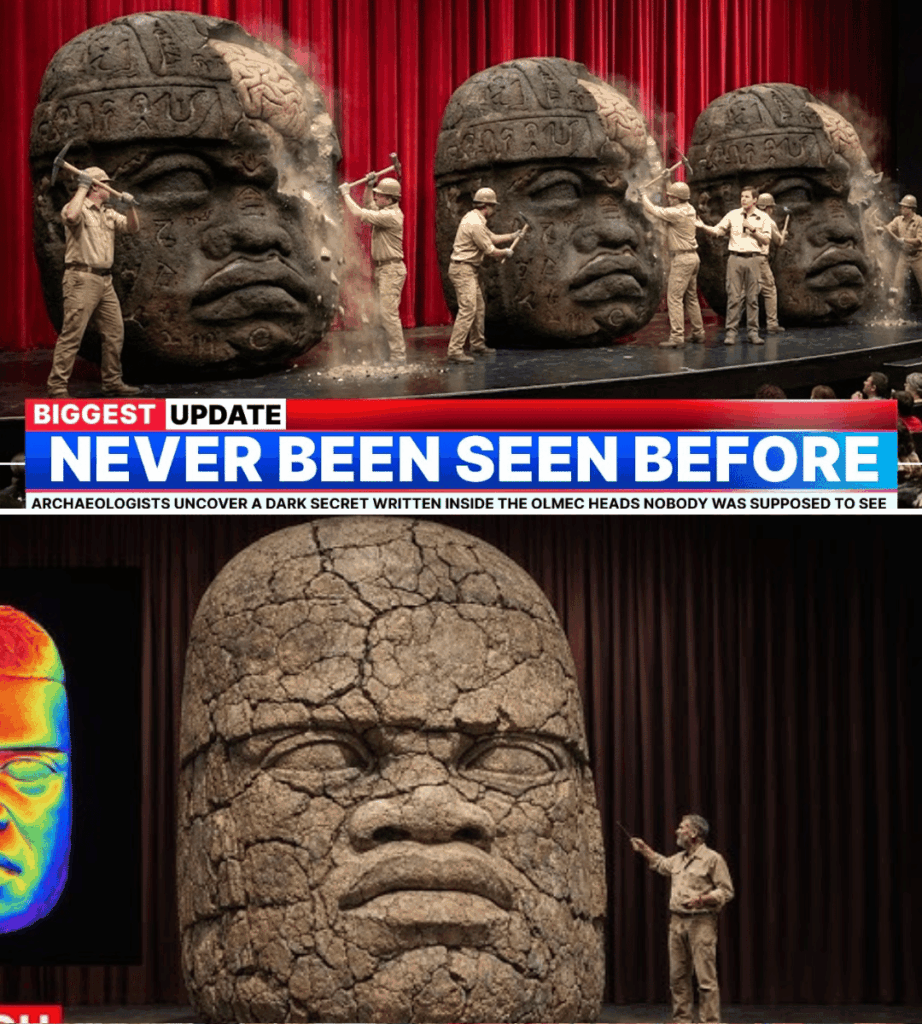
In a groundbreaking revelation, archaeologists have uncovered hidden, ancient faces beneath the famed Olmec colossal heads, exposing a deliberate millennia-old cover-up. Advanced laser scans reveal original carvings predating the Olmec civilization, systematically erased, destroyed, and buried to conceal a dark and disturbing secret nobody was meant to see. For over a century, the colossal Olmec heads—massive volcanic rock portraits scattered across Mexico’s Veracruz and Tabasco regions—stood as enigmatic monuments to a civilization older and more sophisticated than previously known. Weighing up to 50 tons and carved with stunning detail, they were long considered remarkable achievements of the Olmec culture between 1500 and 400 BCE. Yet, recent laser scanning technology, deployed by veteran archaeologist Dr. Anne Ciphers in 2023, has cracked open this ancient mystery. Beneath the visible surfaces lie older, radically different faces carved by an unknown, advanced civilization predating the Olmecs by centuries or more. These hidden layers bear witness to a systematic erasure of history and identity. Dr. Ciphers’ scans revealed a ‘palimpsest’ etched into volcanic basalt—a stone manuscript overwritten multiple times. The Olmecs did not carve these heads from raw rock; they discovered already weathered monuments and altered them by chiseling away original faces, reshaping features with cruder tools, and intentionally masking the advanced craftsmanship beneath. Scientific analysis exposes two distinct carving technologies on the heads: an unknown, supremely sophisticated technique for the original faces, and a simpler, degraded method by the Olmec overlays. The older technology rivals or surpasses anything seen in ancient Egypt or Mesopotamia, shattering assumptions about early Mesoamerican stonework. Adding to the mystery, the basalt used is traced to quarries 60 miles away, through impenetrable jungle swamps, without the aid of wheels or draft animals. Transporting multi-ton stones over such terrain would require unprecedented organization and labor, rivaling civilizations millennia more advanced—a logistical enigma still unsolved. Even more perplexing is the complete archaeological silence regarding the original culture: no pottery shards, no workshop debris, no graves or settlements—none of the usual traces left by societies capable of monumental construction. The original artists vanished without a trace, leaving behind only these colossal, cryptic sculptures. But the Olmecs’ treatment of these heads reveals a darker narrative. Not only did they overwrite the faces, they targeted and defaced sensory features—eyes gouged out, mouths obliterated, noses flattened—in a deliberate, ritualized pattern. This systematic ‘surgical’ destruction speaks to fear or reverence of the message inscribed in those original visages. Following destruction, the heads were ceremonially buried in carefully engineered pits, positioned with precise orientation and accompanied by offerings. This was no abandonment or vandalism; it was a ritual burial intended to silence and contain something powerful, dangerous, and desperately suppressed for over three millennia. Experts now confront an unsettling scenario: a ghost civilization producing impossibly advanced art, erased from history by the very culture that inherited its monuments. The Olmec civilization’s mastery was not a linear progression but a decline from an unknown predecessor, rewriting timelines and challenging entrenched archaeological models. The implications ripple across our understanding of cultural evolution in the Americas. If advanced societies existed long before the Olmecs and disappeared without trace, humanity’s historical narrative demands radical revision. These hidden faces are not merely art; they are the remnants of a lost, sophisticated chapter of human history. Experts emphasize the urgent need to revisit archaeological strategies in Mesoamerica. The layers beneath the Olmec heads compel re-examination of foundational assumptions about early civilization development, technology transfer, and cultural succession. The silence surrounding the ghost civilization must be broken, and its story finally told. Today, the 17 colossal heads reside in museums, admired but misunderstood. Their plaques omit the harrowing revelation beneath the stone—the palimpsest of erased identities, the methodical destruction, and the ceremonial burial. Visitors remain unaware of the secrets still locked deep within volcanic rock. As Dr. Ciphers reflects, after decades studying the site, the question is no longer how the Olmecs moved the heads but who made them first and what terrifying message prompted their erasure. This new evidence forces historians to confront a darker, more complex origin story for Mesoamerican civilization than ever imagined. The discovery demands a reconsideration of ancient history: civilizations capable of exquisite artistry and massive engineering arose, flourished, and disappeared without leaving familiar footprints. The Olmec heads are silent testimonials to this vanished world, obscured through violent overwriting and ritual concealment by successors. What lay etched in those original faces remains unknown, a haunting enigma buried beneath layers of volcanic stone, human endeavor, and time. It is a secret the Olmecs feared enough to erase repeatedly—first by carving over, then by mutilating, and finally by burying their weighty evidence into darkness. The world watches as researchers push the boundaries of archaeology, peeling back layers of stone and history to glimpse a civilization lost to time, whose story challenges our deepest beliefs about progress, culture, and memory. The Olmec heads are more than statues; they are a puzzle of ancient human resilience and secrecy. The discovery has ignited urgent calls within academic circles to increase funding and technological deployment in Mesoamerican archaeology. Advanced scanning tools and interdisciplinary approaches may finally reveal the full extent of this obscured past and the fateful events concealed inside stone giants. Public fascination with these revelations is surging. Social media buzzes with questions about the ghost civilization’s identity and the dark secret erased so thoroughly. The interplay of archaeology, technology, and mystery offers a powerful narrative of lost knowledge and unresolved ancient conflict. Respected experts caution against premature speculation, urging patience while new evidence is analyzed. Yet, one thing is certain: the Olmec heads’ story is far from over. Each scan, each study uncovers deeper mysteries, challenging the archaeological establishment to rewrite history from the ground up. As the investigation continues, it demands recognition that human history may be far more fragmented and complex than previously believed. The Olmec heads stand as monumental beacons, calling scholars and the public alike to confront the shadows lurking beneath the surface of time. This discovery underscores humanity’s enduring quest to understand its origins amid the enduring silence of vanished worlds. The ancient volcanic faces carved in stone are more than relics—they are the key to a hidden chapter of civilization, locked away for thousands of years, begging to be uncovered. Archaeologists now face the daunting task of deciphering not only the physical…