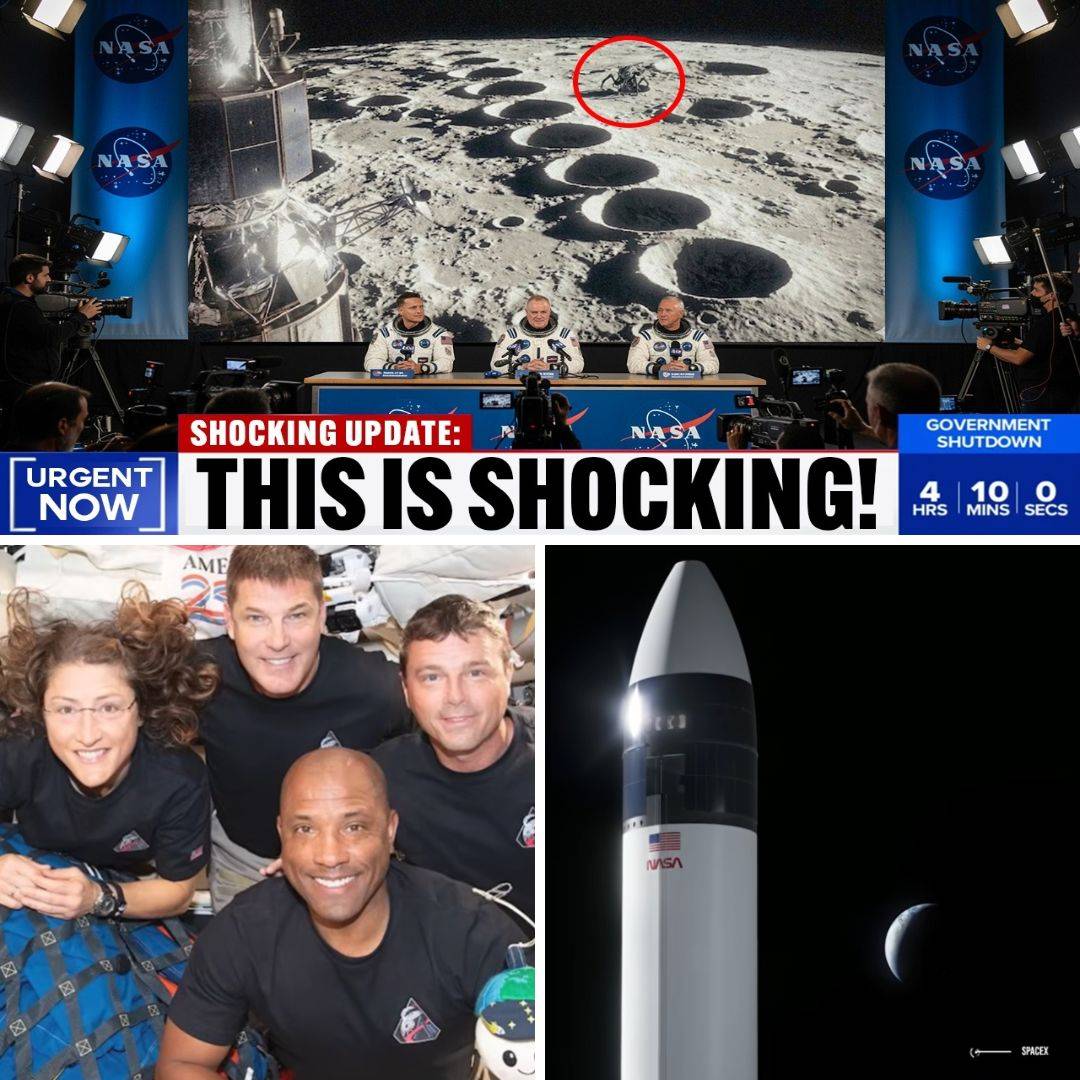
In a stunning revelation from Artemis II’s lunar flyby, astronauts detected inexplicable colors and meteorite impacts on the far side of the moon—phenomena absent from fifty-three years of satellite data. Humanity’s longest moon mission shattered assumptions, exposing critical gaps in lunar science and observation systems that demand urgent reevaluation.
 On April 6th, 2026, as Artemis II orbited approximately 115 kilometers above the far side of the moon, its four-person crew reported unprecedented visual anomalies. Commander Reed Wiseman, Victor Glover, Christina Ko, and Jeremy Hansen observed vivid hues—silver ejecta, green tones, olive swirls, and a blue-white haze—that contradict decades of lunar spectral maps. These colors, detected under unique lighting conditions, are missing from all existing satellite records, challenging long-standing lunar models.
The mission’s trajectory followed a carefully planned free-return path, designed to validate systems for future moon landings. Yet, it was never prepared for the revelations the crew would witness. As Orion passed over complex terrains like the Mare Orientale basin and the massive South Pole-Aitken basin, astronauts noted color gradients and surface hues that defied any known mineral signatures, verified by real-time crosschecks among the crew.
For over fifty years, lunar data relied on satellites like NASA’s Lunar Reconnaissance Orbiter (LRO) and international missions by China and Japan. These unmanned instruments operate with fixed altitudes, angles, and preset spectral parameters—built on the limitations of their launch-era technologies. Subtle color variations visible only under low-angle sunlight and unique perspectives largely escaped detection until human eyes ventured close.
Perhaps more startling, the crew observed four separate meteorite impacts during a forty-minute communication blackout caused by Orion’s passage behind the moon. These brief, sharp flashes were recorded directly by Orion’s instruments and witnessed by all astronauts but missed entirely by any other observation system. This identifies a critical flaw in the global lunar monitoring network: temporal and spatial coverage gaps render many short-lived events invisible unless humans are present to witness them.
The Earth-shine phenomenon during a total lunar eclipse further complicates the picture. Normally too faint for satellite instruments, reflected sunlight from Earth illuminated the moon’s surface in a way previously unmeasurable—casting a soft, ethereal glow and revealing surface coloration unseen by any prior mission. This observation demands immediate reevaluation of lunar spectral data calibration and highlights the limitations of unmanned sensors calibrated exclusively for direct sunlight.
NASA’s ground teams and scientists are now meticulously comparing every Artemis II observation with archived data. Early findings reveal that many detected signals were previously dismissed as noise during processing, filtered out by algorithms aiming for global consistency rather than nuanced detail. The revelation exposes a decades-old feedback loop where data was validated against itself, leaving no room for anomalies outside preconceived models.
 This breakthrough challenges the integrity of lunar surface maps that have underpinned scientific understanding and mission planning, including the upcoming Artemis III landing near the lunar south pole. It underscores a glaring verification problem: for over half a century, no independent external observation from human eyes existed to cross-validate or refute satellite data under varied lighting and viewing conditions.
The Artemis II crew’s unique vantage point and real-time human observations represent the first external check on fifty years of remotely gathered data. Their findings mark the beginning of a paradigm shift in lunar science, demanding urgent updates to existing mineralogical models, spectral databases, and risk assessments crucial for safe landings.
This mission’s anomalies do not suggest conspiracies or extraterrestrial phenomena but instead expose natural limitations of past and present lunar observation techniques. The combined visual reports of silver ejecta, green hues on the South Pole-Aitken basin floor, olive swirls near Von Kármán Highlands, and the blue-white Earth-shine haze necessitate fresh scientific inquiry grounded in human perception beyond algorithmic confines.
As Artemis II pushes humanity’s boundaries, it reveals the inherent value of human presence in space exploration—not merely as passengers but as observant scientists capable of detecting what machines programmed with fixed parameters cannot. The revelation recasts our understanding of the moon’s surface and insists on incorporating human-led observations in future mission designs.
NASA’s upcoming Artemis III planning is already adapting to these discoveries, revising target sites and instrumentation to address the newly documented gaps and phenomena. The mission aims to build a more accurate, multidimensional lunar map that accounts for variable lighting, angles, and spectral nuances missed for decades.
At the heart of this breakthrough is a profound lesson: reliance on automated, preset observation systems leaves critical details undetected, creating an echo chamber of repeated confirmations without true validation. Artemis II’s data punctures this closed loop, pushing lunar science into uncharted territory requiring fresh eyes and updated tools.

The future of lunar exploration now hinges on embracing these findings, integrating human observation with advanced technology, and reexamining established models with humility and rigor. Artemis II’s discoveries compel the scientific community to confront the boundaries of prior knowledge and prepare for unexpected revelations in the next phase of space exploration.
This historic mission proved that even with 175 gigabytes of imagery and comprehensive pre-mission mapping, the moon can still surprise us when seen firsthand. Artemis II’s crew has permanently expanded humanity’s lunar perspective, setting a new standard for vigilance, openness, and scientific renewal.
As Artemis III approaches, the space community faces the urgent task of reevaluating risk assessments and surface compositions based on Artemis II’s unexpected findings. The implications could reshape landing site selections, mission safety protocols, and our broader understanding of the moon’s geological history.
No longer a remote rock fully understood by satellite eyes alone, the moon has revealed a more complex, dynamic face—viewed through human eyes orbiting higher and farther than anyone since Apollo 17 in 1972. Artemis II’s revelations mark not an end, but a bold beginning in renewed lunar exploration.
Scientists analyzing the Artemis II data emphasize that these anomalies will take years to fully understand and incorporate into lunar science. Yet the urgency is clear: mission plans rely on accurate, complete data sets, and Artemis II has proven existing maps are incomplete under critical conditions.
 This unfolding story exemplifies a pivotal moment in space exploration history—where human presence meets technology to correct assumptions and enrich our grasp of celestial realities. Artemis II’s observations set a new precedent for how we study not only the moon but planetary bodies beyond.
The Artemis II findings promise to ignite extensive research and debate, challenging decades of lunar doctrine resting on unverified remote sensing alone. The message is unmistakable: true understanding demands the integration of human sensory experience with cutting-edge instrumentation.
As Artemis II’s crew returned with these extraordinary observations, the moon’s familiar face suddenly appeared enigmatic and layered with unexplored details, prompting a necessary reevaluation that could shape humanity’s extraterrestrial future.
The Artemis II mission didn’t just push distance records; it shattered long-held assumptions about what we know—and don’t know—about the moon, illuminating the profound role that human observation plays in cosmic discovery.
With Artemis III underway, the world watches as NASA and its partners prepare to revisit the moon armed with new insight and a renewed commitment to question, observe, and understand beyond traditional data constraints.
Subscribe to updates and monitor official releases closely. Artemis II’s revelations mark a watershed moment in lunar exploration—one that could redefine humanity’s relationship with its closest celestial neighbor forever.