DECADES LONG INVESTIGATION INTO SHROUD ENDS WITH EMOTIONAL REVELATION
For nearly half a century, a quiet, methodical investigation unfolded around one of the most mysterious artifacts in human history—the Shroud of Turin.
At the center of this decades-long journey was Barrie Schwortz, a Jewish scientist and photographer whose work would place him at the crossroads of science, faith, and one of the most controversial relics ever examined.
What began as a strictly technical assignment evolved into a lifelong pursuit of answers—one that, according to recent retellings, reached a deeply emotional turning point centered around something as small as a single molecule.
Schwortz first became involved with the Shroud in 1978 as part of the Shroud of Turin Research Project (STURP), a team of scientists granted rare access to the cloth.
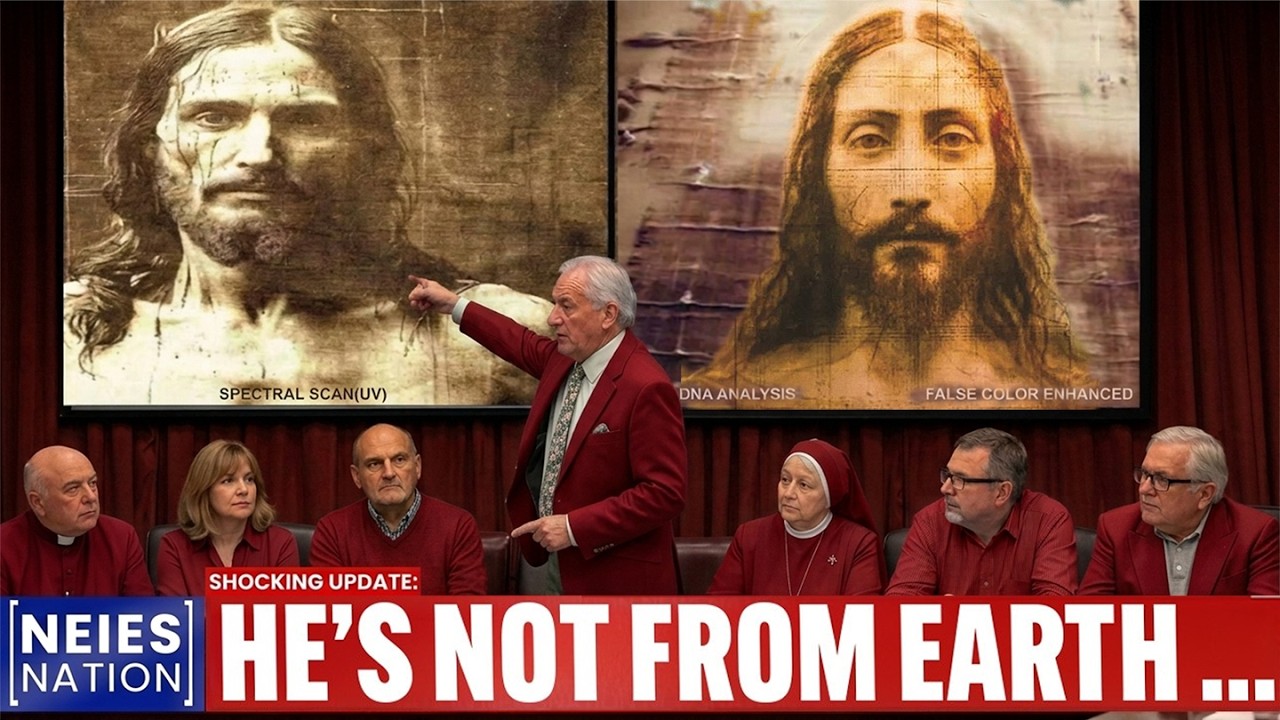
Their mission was straightforward in principle: apply modern scientific tools to analyze the image imprinted on the linen and determine how it was formed.
For Schwortz, trained in documenting evidence through photography, the assignment was not about belief.
It was about observation, data, and reproducibility.
At the time, the Shroud had already been the subject of centuries of debate.
The faint image of a man bearing marks consistent with crucifixion had led many to associate it with Jesus Christ.
Others dismissed it as a medieval fabrication, pointing to the lack of clear historical documentation prior to the Middle Ages.
The STURP investigation was expected, by some, to settle the question once and for all.
What the team discovered, however, only deepened the mystery.
High-resolution imaging revealed that the figure on the cloth was not painted, dyed, or scorched in any conventional sense.
The discoloration existed only on the topmost fibers of the linen, penetrating less than a fraction of a human hair’s thickness.
There were no brush strokes, no pigments, no directionality that would suggest an artist’s hand.
Even more puzzling, the image contained three-dimensional information—when analyzed using specialized imaging equipment, it produced a relief-like structure corresponding to the shape of a human body.
For Schwortz, these findings were both fascinating and unsettling.
They did not provide a clear answer, but they challenged assumptions.
As the years passed, he continued to study, document, and present the data, often emphasizing that the role of science was not to confirm religious belief, but to understand physical evidence.
Yet the evidence itself refused to conform to known processes.
The reference to “one molecule” in recent narratives is often used as a dramatic symbol of this tension between certainty and mystery.
In scientific terms, the Shroud has been analyzed at microscopic and even molecular levels.

Researchers have examined the chemical composition of the fibers, the presence of possible contaminants, and the effects of aging and environmental exposure.
While no single molecule has been identified as a definitive turning point, the cumulative effect of these analyses has been to highlight how little is fully understood.
In some accounts, the phrase represents a moment of realization—an instance where the smallest detail underscores the limits of current knowledge.
For a scientist accustomed to clear explanations, confronting an anomaly at the most fundamental level can be profoundly impactful.
It is not necessarily a moment of collapse, but one of recognition: that the phenomenon being studied may not yet have an explanation within existing frameworks.
Schwortz himself has consistently maintained a careful position.
He has stated that while the Shroud’s image remains unexplained, this does not automatically validate any specific religious claim.
At the same time, he has acknowledged that the data challenges conventional understanding, leaving open questions that science has yet to resolve.
The emotional dimension of this story lies not in a single experiment, but in the accumulation of decades of inquiry.
To dedicate nearly fifty years to a subject without reaching a definitive conclusion requires persistence, curiosity, and a willingness to accept uncertainty.
For many researchers, this process can be both intellectually stimulating and personally demanding.
The broader public response to such narratives often gravitates toward dramatic interpretation.
The idea that a hardened scientist could be “broken” by a single discovery is compelling, but it simplifies a far more nuanced reality.
Scientific work rarely unfolds in sudden, decisive moments.
Instead, it progresses through incremental findings, revisions, and ongoing debate.
At the same time, the enduring fascination with the Shroud reflects something deeper than scientific curiosity.
It sits at the intersection of material evidence and spiritual meaning, inviting questions that extend beyond measurement.
For believers, it can serve as a symbol of faith.

For skeptics, it represents an unresolved puzzle.
For researchers like Schwortz, it is both an object of study and a reminder of the limits of current knowledge.
Advances in technology continue to offer new opportunities for analysis.
Techniques such as spectroscopy, digital imaging, and material science provide tools that were not available during the initial STURP investigation.
Each new study adds to the body of knowledge, yet the central question—how the image was formed—remains unanswered.
This persistence of mystery is part of what keeps the Shroud relevant.
In an era where many phenomena can be explained with precision, an object that resists explanation stands out.
It challenges assumptions about what can be known and how knowledge is acquired.
For Schwortz, the journey has been as significant as the findings themselves.
His work has contributed to a deeper understanding of the Shroud’s physical properties, even if it has not resolved its origin.
In doing so, it has also highlighted the importance of maintaining a balance between skepticism and openness—questioning evidence without dismissing it, and exploring possibilities without jumping to conclusions.
The story of “one molecule” ultimately serves as a metaphor for this balance.
It represents the idea that even the smallest detail can carry profound implications, not because it provides an answer, but because it reveals the complexity of the question.
As discussions about the Shroud continue, the narrative surrounding Schwortz’s decades of research underscores a central theme: the pursuit of truth is rarely straightforward.
It involves uncertainty, revision, and sometimes the acknowledgment that not all questions have immediate answers.
In the end, the impact of this story lies not in proving or disproving a specific claim, but in illustrating the enduring relationship between science and mystery.
The Shroud of Turin remains an object of study, debate, and fascination—a reminder that even in a world driven by data, there are still phenomena that challenge understanding at every level, from the visible image to the smallest molecule within its fibers.