California’s high-speed rail project was once sold as a symbol of modern ambition—a sleek, electrified line that would connect Los Angeles and San Francisco in under three hours. Voters approved it in 2008 as a forward-looking investment in mobility, climate goals, and economic development. Nearly two decades later, the dream faces a harsh reckoning.
The Federal Railroad Administration recently moved to terminate roughly $4 billion in unspent federal funds tied to the project, adding fresh uncertainty to a program already defined by missed deadlines, revised budgets, and political crossfire. According to federal summaries, approximately $15 billion has already been spent over a 16-year timeline, with projected total costs now estimated near $135 billion—far above the roughly $33 billion figure initially presented to voters.
The numbers dominate headlines. But the deeper issue is structural.
Large infrastructure projects in the United States operate within a maze of shared authority. State agencies may lead construction, yet they must negotiate permits, rights-of-way, environmental reviews, and utility coordination city by city. Every jurisdiction becomes a potential choke point. Litigation, environmental challenges, and local opposition have repeatedly slowed the rail line’s development.
Environmental review, in particular, proved both necessary and costly. Impact studies and mitigation requirements stretched timelines. Lawsuits—some rooted in legitimate land-use concerns, others driven by neighborhood resistance—added years to the process. Delays themselves became financial multipliers. Contractors filed change orders as schedules slipped. Legal teams expanded. Consulting contracts grew.
Federal funding assumptions added another layer of fragility. Early projections anticipated significant long-term federal contributions that never fully materialized. Political shifts in Washington reshaped priorities, leaving California to shoulder a heavier share of financing. When federal money pauses or disappears midstream, states face difficult choices: borrow more, cut other programs, or scale back the original vision.

Today, the most visible construction is concentrated in the Central Valley, spanning approximately 119 miles, with plans to extend that to roughly 171 miles between Merced and Bakersfield. While technically progress, that segment falls far short of the Los Angeles–San Francisco corridor that voters envisioned. Critics have labeled it a “train to nowhere,” arguing that without coastal endpoints, the system cannot fulfill its original promise.
Supporters counter that mega-projects unfold in phases. They argue that building the central spine first establishes the foundation for future extensions. They also emphasize long-term environmental benefits and economic development in underserved regions.
Yet public trust has eroded.
As costs ballooned and timelines slipped, skepticism deepened—not only about feasibility but about oversight. Mega-projects require armies of contractors, subcontractors, logistics firms, and consultants. Each additional layer introduces complexity. Oversight remains in place, but as systems grow, accountability can diffuse across agencies and jurisdictions.
That complexity creates fertile ground for inefficiency—and, in rare cases, abuse.
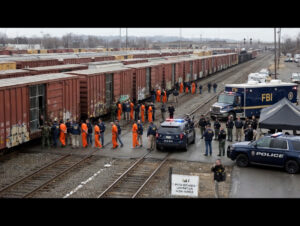
Recent investigative reporting has drawn attention to vulnerabilities in large-scale freight and rail logistics systems more broadly. While no credible evidence links California’s high-speed passenger rail construction to criminal conspiracies of the kind sometimes dramatized online, law enforcement officials acknowledge that freight corridors nationwide present unique oversight challenges. Rail networks cross state lines, blend public and private infrastructure, and operate around the clock. Monitoring such systems requires coordinated federal, state, and local effort.
The broader lesson is not one of hidden drama, but of institutional strain.
When projects stretch across decades, the political coalition that launched them can fragment. Early champions leave office. New administrations inherit obligations without owning the original narrative. Meanwhile, debt service obligations accumulate quietly in state budgets, appearing not as a single line item but as trade-offs in education, healthcare, or local transit funding.

For Central Valley communities, the impact is tangible. Construction zones alter traffic patterns. Agricultural land negotiations stir tensions. Residents hear about future high-speed connections while navigating present-day disruptions.
For coastal commuters, the project exists largely as an abstraction—an expensive promise that has yet to materialize in daily life.
Infrastructure experts note that the United States historically struggles with large rail initiatives compared to countries with centralized planning structures. Fragmented governance, layered environmental review, and shifting funding streams make long-term execution uniquely difficult.

The Federal Railroad Administration’s decision to reconsider funding does not necessarily end the project, but it intensifies pressure. California officials must either secure alternative financing, restructure the scope, or risk leaving a partially built system that struggles to justify its cost.
Critics argue the state should cut losses and redirect funds to existing transportation upgrades. Supporters warn that abandoning the project midstream would strand billions already invested and forfeit future benefits.
Beyond politics, the episode underscores a broader truth: mega-projects amplify both ambition and vulnerability. They require sustained political will, transparent oversight, and realistic cost forecasting. Without those pillars, public confidence erodes—even if no single act of misconduct occurs.

California’s high-speed rail began as a symbol of 21st-century mobility. Today, it stands as a case study in the challenges of delivering transformative infrastructure within a decentralized democratic system.
Whether it ultimately becomes a functioning statewide network or a scaled-back corridor will depend on financing, political alignment, and public tolerance for continued investment.
What is certain is this: the rail line is no longer just about trains. It has become a referendum on governance itself—on how states manage vast sums, coordinate across jurisdictions, and maintain accountability over time.
The trains have yet to run between Los Angeles and San Francisco. But the debate over how—and whether—to finish the line is already reshaping California’s political and fiscal landscape.