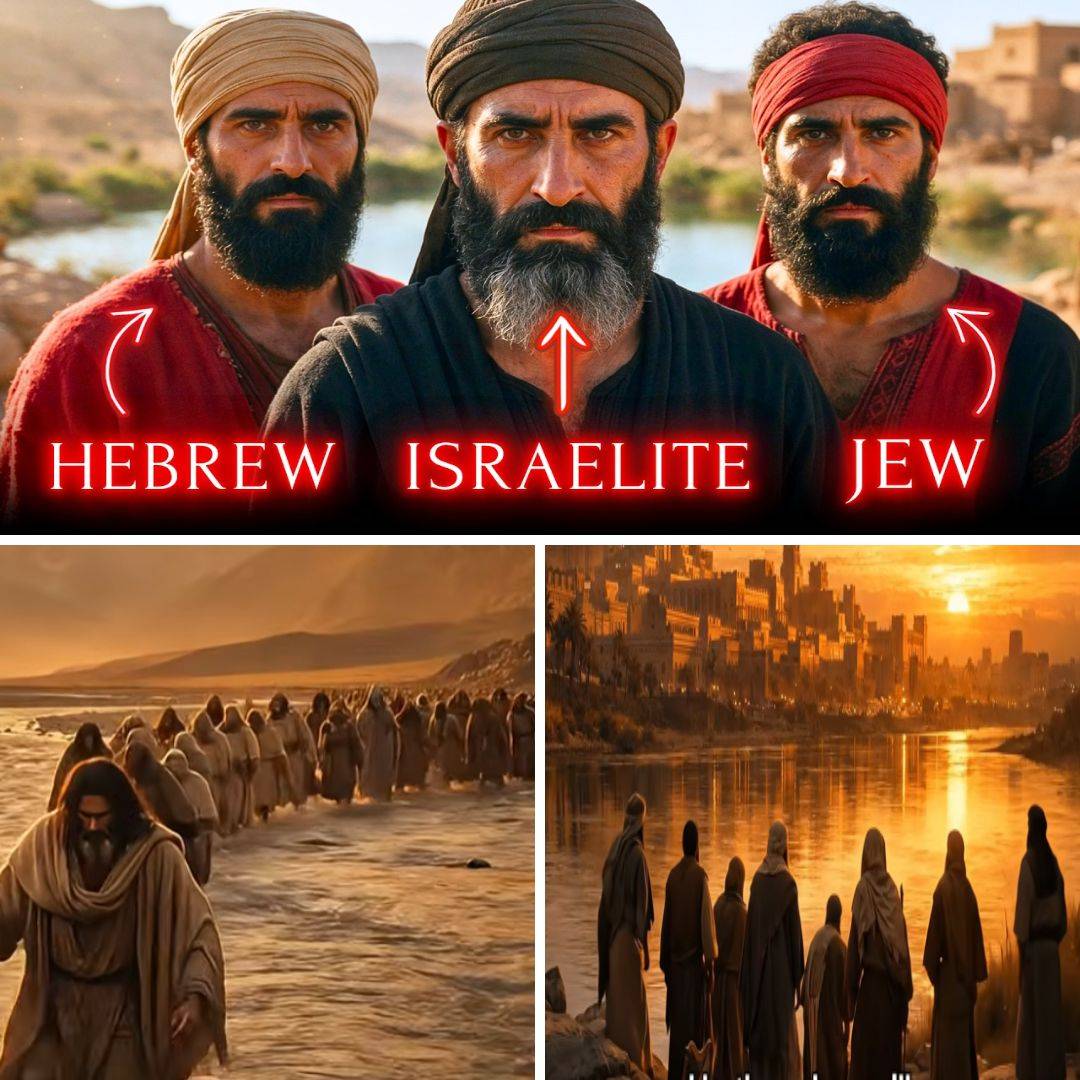
A profound revelation shakes the foundations of biblical understanding worldwide: the words Hebrew, Israelite, and Jew are not interchangeable labels but distinct identities forged at separate, pivotal moments in history. This explosive clarification redefines faith, heritage, and scripture interpretation permanently.
 For millennia, millions have unknowingly conflated Hebrew, Israelite, and Jew as synonyms, unaware of their separate origins and powerful stories within the Bible. The startling truth reveals that Abraham, Moses, and even King David were never called Jews. The term only appears centuries later, marking profound shifts in identity and history.
The journey begins with the word Hebrew, the oldest and most enigmatic. Meaning “one who crosses over,” Hebrew first describes Abram after he obeys God’s command to leave his homeland and cross the Euphrates River. This label was originally a slur by ancient kings, branding Hebrews as restless outsiders and nomads—people who belonged nowhere.
Another origin links Hebrews to Eber, a forgotten ancestor from Genesis, whose name also means “the other side,” symbolizing crossing boundaries physically and spiritually. This double meaning encapsulates the destiny of Abraham’s line—a people defined by movement, exile, and faith in the unknown. The Egyptians and Philistines called them Hebrews with disdain.
Archaeology deepens the mystery: ancient tablets speak of the Habiru, landless, marginalized nomads resembling Hebrews. Whether Habiru and Hebrews are directly connected remains debated, but both represent drifting outsiders chosen by God to become a nation through Abraham’s promise—a transformative crossing that shapes history’s trajectory.
Yet Abram was just one man, not a people. The second step emerges with his grandson Jacob, renamed Israel after a dramatic all-night wrestle with a mysterious figure. Israel means “the one who wrestles with God” or “God wrestles,” signifying a profound covenant. From Israel sprang twelve tribes, united as Israelites—descendants of a legacy born through struggle.

The Bible shifts from “Hebrews” to “Israelites” to describe the collective people during their Exodus years, wilderness wanderings, and settlement in the promised land. Israelite is an insider’s word: a community bound by covenant, law, and land—a radical departure from the wandering pilgrim identity of Hebrew.
For hundreds of years, Israel thrived under kings Saul, David, and Solomon, with Jerusalem and its temple as spiritual and political centers. But Solomon’s death fractured the kingdom into two: the northern kingdom of Israel with ten tribes and the southern kingdom of Judah with two tribes—setting the stage for the final, shattering transformation of identity.
The third and final step is born from catastrophe. In 722 BCE, Assyria destroys northern Israel and disperses the ten tribes into oblivion. The people of Judah endure alone until 587 BCE, when Babylonian armies besiege Jerusalem, destroy Solomon’s temple, and exile the Judeans. Here, the identity Jew is conceived under fire and loss.
In Babylon, the survivors, stripped of land, temple, and king, cling to an identity drawn from the tribe of Judah. “Yehudi,” or Jew, emerges among exiles and becomes their new name, spreading through Greek, Latin, and finally English as “Jew.” This name forged in exile carries the weight of survival, faith, and reinvention amid despair.

From this crucible of exile sprang the synagogue, rabbis, and the Hebrew Bible’s final form—pillars sustaining the scattered people through millennia. The exile shattered but also saved them, forcing a spiritual and cultural rebirth that preserved memory, tradition, and hope in a hostile world without homeland or temple.
When the Persian king Cyrus allowed the exiles to return, the people who emerged were no longer just Israelites; they had become Jews. With a shared identity grounded in resilience and faith, they rebuilt Jerusalem, reinvigorated worship, and carried a legacy enduring to the present day—changed forever by exile’s forging fire.
Centuries later, the Roman governor Pilate’s sign over Jesus’ cross declared him “King of the Jews,” signaling the world’s definitive shift from Israelite monarchy to Jewish identity. Jesus himself embodied all three identities: Hebrew by language and faith, Israelite by lineage, and Jewish by nationality and covenant.
Jesus’ genealogy in the Gospel of Matthew traces back to Abraham, the first Hebrew, highlighting the primordial crossing and covenant. The Gospel of John reveals Jesus’ understanding of true Israelite identity as one free of deceit, a transformed legacy of Jacob’s prophecy. He walked in Hebrew, worshipped as a Jew, and belonged to Israel’s tribes.

The Apostle Paul exemplifies this complex identity, using Hebrew, Israelite, and Jew strategically in various contexts to express origins, covenant membership, or legal standing. His nuanced use confirms these terms are distinct, each highlighting a different facet of heritage and belief embedded in scripture and history.
Hebrew evokes the ancient root of crossing over with Abraham; Israelite reveals the covenant community descended from Israel; Jew embodies the historical reality born from exile in Babylon, a people reshaped by suffering into a vibrant faith. These three words together chart a dramatic saga of survival, identity, and divine purpose.
Today, Hebrew remains the sacred language of Jewish prayer and scripture. Israeli describes citizens of the modern state linked to ancient Israel. Jew defines a religion, culture, and people whose origins reflect millennia of history etched in three powerful names that echo the Bible’s vast, unfolding human 𝒹𝓇𝒶𝓂𝒶.
This revelation challenges every Bible reader, historian, and believer: Hebrew, Israelite, and Jew are not synonyms but pivotal stages in a timeless story. Understanding their distinctiveness is not merely academic—it transforms how we comprehend scripture, heritage, and the journey of a people chosen to cross over, wrestle, and endure.