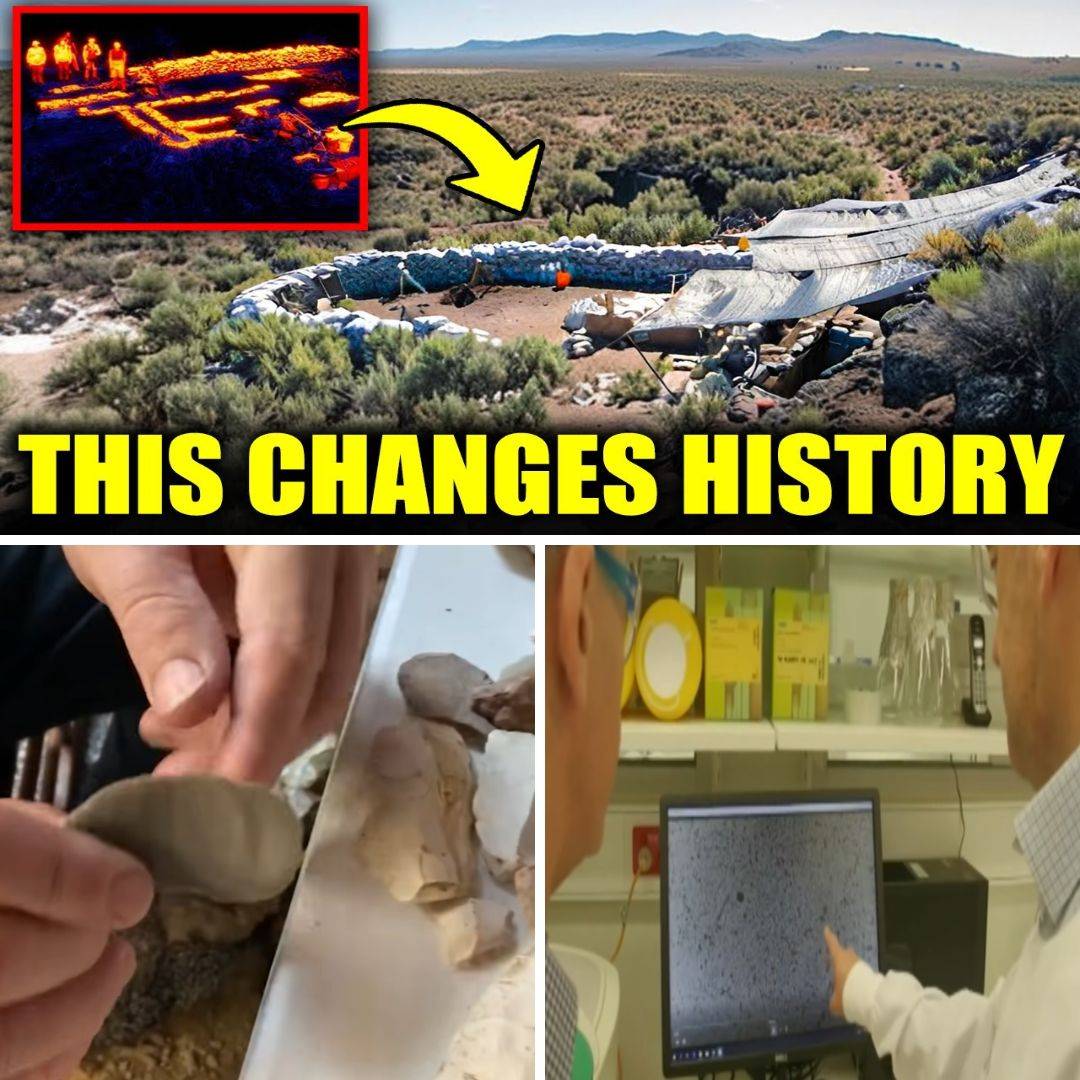
Archaeologists at the University of Oregon have uncovered the oldest confirmed human settlement in North America at Rimrock Draw, Oregon, dating back over 18,000 years—thousands of years earlier than previously believed. This groundbreaking discovery shatters existing timelines and challenges long-held beliefs about the arrival and migration of early humans in the Americas.
 Beneath a preserved layer of volcanic ash from Mount St. Helens, researchers unearthed stone tools and butchered remains of the giant extinct camel, Camelops hesteris. The volcanic ash, dated over 15,600 years old, sealed the site, providing an undisturbed, secure timeline for these early human activities. This evidence overturns the established Clovis-first theory.
For decades, experts believed humans arrived in North America around 13,000 years ago, moving through ice-free corridors. Rimrock Draw’s artifacts predate this by thousands of years, during the last glacial maximum, a period when overwhelming ice sheets should have blocked human migration. The site’s existence demands a full reassessment of migration routes and theories.
The discovery began as a routine excavation aimed at studying Ice Age fauna and environmental trends. Instead, pristine sediment layers with repeated human presence emerged. Stone tools, systematically crafted scrapers made from orange agate sourced from distant locations, appeared in multiple stratified layers, revealing planned and sustained human occupation.
Unlike many archaeological sites affected by erosion or bioturbation, Rimrock Draw’s sediment layers remained flat, sharp, and undisturbed. This preservation provided a clear, chronological sequence of human activity rather than chaotic, mixed deposits. Excavation unearthed multiple layers showing distinct episodes of humans returning to and utilizing this rock shelter repeatedly.
The turning point came with the discovery of cut-marked bones of Camelops hesteris, a seven-foot-tall extinct camel species previously unknown in association with human butchering in the region. The marks proved deliberate human tool use for cutting meat, not carnivore or natural damage, solidifying the assertion that humans hunted and processed large Ice Age megafauna here.
 Radiocarbon dating cemented the timeline: the camel tooth enamel returned an age of approximately 18,250 years before present. This date stands in direct contradiction to the Clovis-first model, which places human arrival over 5,000 years later and relies on an impossible migration through still-glaciated interior corridors at that time.
Further compelling evidence came from residue analyses on the stone scrapers. Proteins extracted matched those from Bison antiquus, an extinct Ice Age bison species. This molecular-level confirmation ties the tools directly to butchering activities, removing any lingering doubts regarding human involvement and the antiquity of the site’s use.
The discovery forced archaeologists to question the long-held ice-free corridor migration hypothesis. Geological data affirms such corridors did not open until well after the date indicated by Rimrock Draw. Instead, early humans likely followed a coastal migration route—using watercraft and rich marine resources—bypassing glaciated inland regions.
The Rimrock Draw findings show the sophistication of these early settlers. Evidence of tool transport, repeated site use, and hunting strategies reflects advanced planning, environmental adaptation, and social organization far earlier than textbook timelines suggest. These people were not accidental wanderers; they were skilled, persistent inhabitants shaping North America’s prehistoric narrative.
Unexcavated deeper layers at Rimrock Draw hint at even earlier human presence. Preliminary signs of stone tool production in sediments below the camel bone layer suggest occupation predating 18,250 years ago. This invites further investigation to potentially push the timeline of human settlement in North America back even further.

This discovery triggers an urgent call to revisit numerous sites long considered secondary or irrelevant due to outdated chronological assumptions. Regions dismissed as inhospitable or inaccessible during the Ice Age, especially coastal and volcanic areas, must be reevaluated for possible early human activity predating Clovis culture.
Rimrock Draw fundamentally disrupts the prevailing archaeological framework, demanding new strategies in search and excavation. The reliance on surface and upper stratigraphy must give way to deeper, more nuanced approaches to uncover hidden evidence—acknowledging that critical chapters of human migration and adaptation remain buried beneath layers once overlooked.
Beyond rewriting migration models, the site redefines early human capability in North America. The presence of specialized tools made from non-local materials demonstrates complex knowledge, trade or travel over long distances, and resource management. These revelations expand understanding of Ice Age human resilience and ingenuity on the continent.
The scientific rigor supporting Rimrock Draw’s significance is unassailable. Independent geological dating, stable stratigraphy, artifact consistency, cut-mark analysis, and molecular residue evidence collectively negate challenges to its authenticity. This multidisciplinary validation leaves no room for dismissing or ignoring the profound implications it carries.
 Historians and archaeologists face a turning point; the site dismantles a 20th-century orthodoxy that defined American prehistory. The Clovis-first theory, once untouchable, now stands revealed as incomplete—a relic of outdated assumptions, reshaped by unequivocal evidence that early humans were established in North America far earlier than recorded.
As excavation continues, Rimrock Draw promises to deepen understanding of ancient human lifeways during a climatically brutal era. Preserved artifacts and environmental data offer a real-time glimpse into survival strategies, tool use, and community behaviors under Ice Age conditions long before previously accepted timelines.
The impact resonates beyond academia, challenging public perceptions of when humanity first settled the Americas. It emphasizes that human history is continuously evolving, shaped by new discoveries that compel us to rethink migration, adaptation, and the interconnectedness of prehistoric peoples with their environments.
Rimrock Draw’s revelations serve as a reminder of the dynamic and still unfolding nature of scientific inquiry. What seemed certain is now questioned, and what was dismissed is now critical. This site not only rewrites timelines but transforms the narrative of human endurance and exploration on the planet’s last frontier.
The institution leading this monumental breakthrough, the University of Oregon, underscores the importance of sustained archaeological funding and multidisciplinary collaboration. The deeper, untouched layers of Rimrock Draw hold potential answers that could further revolutionize human history in North America, warranting global scholarly attention.
As the dust settles on this landmark discovery, one truth emerges clearly: the story of America’s first inhabitants is far more complex, ancient, and remarkable than once thought. Rimrock Draw marks the dawn of a new epoch in archaeological research and human understanding, setting the stage for discoveries yet to come.