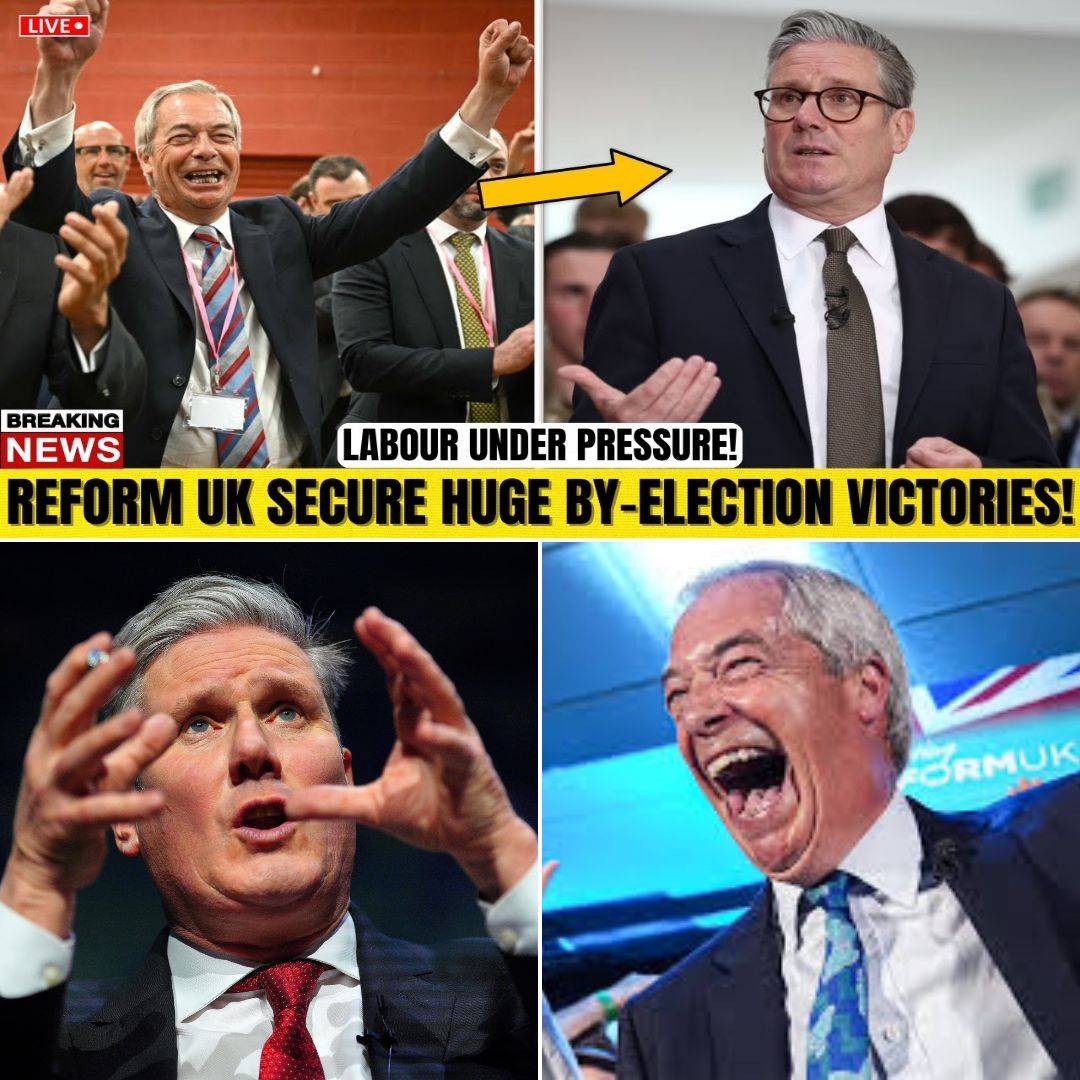
Reform UK has achieved a historic breakthrough, securing four major council by-election victories, including its first-ever electoral win in Scotland. The party’s sweeping success, marked by significant vote share gains across key wards, signals a dramatic shift in local political loyalties and challenges traditional powerhouses across the UK’s political landscape.
 In a closely watched contest in West Lothian’s Whitburn and Blackburn ward, Reform UK surged ahead, clinching first place with 32% of the vote. This marks the party’s inaugural council seat in Scotland, breaking entrenched patterns dominated by Labour and the SNP. Labour’s share plummeted to 17.1%, down more than 20 points, while the SNP secured 28%, also falling over 10 points.
The West Lothian result stands as a seismic shift in Scottish local politics, illustrating a loosening grip of traditional parties and a new appetite among voters for Reform UK’s platform. Nigel Farage, commenting on the outcome, described the victory as “very strong,” emphasizing its symbolic significance north of the border.
Reform UK’s momentum did not stop there. In England, the party captured the Belmont ward in South Kesteven by an astonishingly narrow 0.3 percentage point margin over the Conservatives, despite having not fielded a candidate there in 2023. The win disrupted local independents’ hold on the seat, highlighting the volatile nature of local contests.
Meanwhile, in Arveland ward, also in South Kesteven, Reform UK recorded a decisive victory, climbing to 41% of the vote from a standing start and unseating the Conservatives. A notable swing of 3.8% helped the party clinch this seat, drawing from a complex contest where the absence of Liberal Democrat candidates reshaped voter dynamics.
Further north in Darlington’s Red Hall and Lingfield ward, Reform UK seized another trophy by overtaking Labour with 37.7% of the vote. Labour suffered a devastating 37.1-point plunge, their vote collapsing in an area long regarded as a Labour stronghold. Meanwhile, the Conservatives trailed significantly, with only 17.3%.
The mixed results painted a kaleidoscope of change across local councils. In Stockton-on-Tees’ Eaglescliffe West ward, the Conservatives successfully defended their seat with 60.9% of the vote, increasing their share, while Reform UK improved its numbers to 24%. Labour’s support again fell sharply here, down by more than 21 points.

Reform UK chairman Dr. David Bull framed the results as evidence of the party’s rapid rise, noting they have won more council by-elections since the local elections than the Conservatives, Labour, and the Green Party combined. He cited this as proof that the party’s growing national polling strength translates directly into electoral success.
Analysts stress these by-election results reveal localized voter volatility and shifting allegiances rather than sweeping national trends. Local issues, candidate profiles, and community concerns heavily influence outcomes, particularly in council contests known for lower turnouts compared to general elections.
Nevertheless, Reform UK’s breakthrough in Scotland, along with significant gains across England, challenge established assumptions and underscore the evolving political battleground. Traditional parties face an urgent need to bolster voter engagement and adapt strategies as Reform UK capitalizes on growing disenchantment.
These developments inject fresh urgency into the UK’s political discourse, with by-elections proving crucial testing grounds for party organization and outreach ahead of future national elections. Reform UK’s ability to secure council seats marks a strategic advance beyond mere opinion polls.
As further by-elections unfold, all eyes will remain fixed on whether Reform UK can maintain momentum and convert this surge into sustained local and national influence. Established parties will confront mounting pressure to shore up support in a rapidly shifting electoral environment.

The current wave of results also magnifies the fragile nature of traditional loyalties, revealing deep voter volatility even in historically secure heartlands. For Labour and the Conservatives, these mixed fortunes highlight the complex terrain of British politics at grassroots level.
Scotland’s political landscape, notably volatile and competitive, displayed a stark indication that Reform UK can now compete and triumph in areas long held by dominant regional forces. This breakthrough could recalibrate future electoral dynamics north of the border.
Reform UK’s latest achievements demonstrate how local elections serve as valuable barometers for public sentiment and institutional strength. They also reflect the strategic importance of grassroots campaigning and sustained voter contact, critical elements for political success.
While by-elections do not determine national governance, their outcomes carry symbolic weight and practical implications for party morale and momentum. Reform UK’s triumphs signal they have become a force to reckon with in the UK’s evolving political arena.
The coming months promise intense scrutiny as parties interpret these results and prepare for broader contests. The pace and intensity of political change underscore an unpredictable and rapidly shifting democratic landscape across the United Kingdom.

Reform UK’s breakthrough heralds a new chapter in British local politics, where emerging political forces disrupt long-standing power structures and reshape the electoral map with surprising speed and impact.
As the dust settles on this unprecedented round of council by-elections, stakeholders across the spectrum will reassess strategies, knowing voter engagement and electoral competition have reached new levels of complexity and intensity.
This wave of Reform UK victories intensifies the political stakes, signaling increased competition and the potential for further realignments ahead of key elections, both locally and nationally.
For voters, these results underscore a dynamic political environment where new voices gain ground and traditional allegiances face significant challenges, reflecting broader societal shifts and demands for change.
In conclusion, Reform UK’s dramatic surge across multiple councils, capped by its historic Scottish council win, marks a pivotal juncture. The party’s success disrupts political norms, reshapes local power balances, and signals a volatile era ahead for UK politics, demanding close attention in the months to come.